
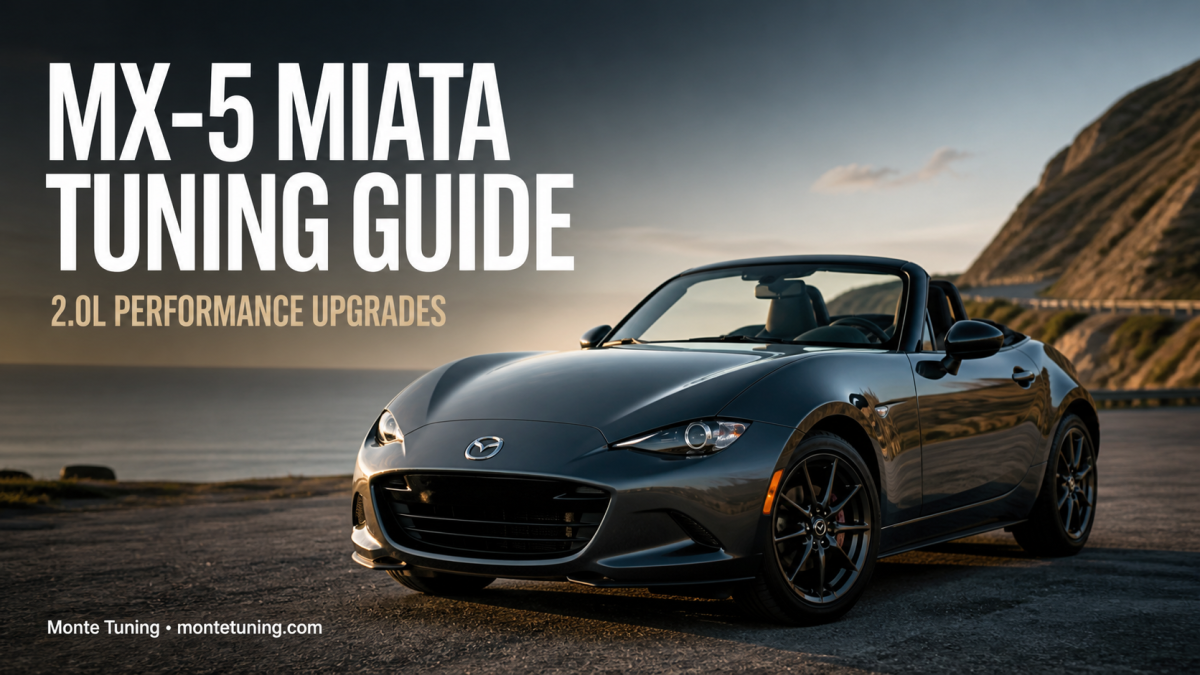
ECU tuning for the 2.0L Mazda MX-5 Miata is a method of optimizing the engine control unit’s software to improve throttle response, torque delivery, and fuel efficiency. By adjusting ignition timing, air-fuel ratios, and variable valve timing via the OBD2 port, owners can unlock performance potential without permanent modifications.
Understanding the 2.0L Performance Potential
The Mazda MX-5 Miata is defined by its chassis balance and handling, but many enthusiasts find the naturally aspirated 2.0L engine leaves room for improvement, particularly in daily drivability. Whether you are driving an NC generation with the MZR engine or the newer ND generation with the Skyactiv-G powerplant, factory software is intentionally conservative.
Manufacturers calibrate these engines to account for varying global fuel qualities, extreme climates, and strict emissions regulations. This often results in a noticeable throttle lag and a torque curve that feels flat in the mid-range—the exact area where most drivers spend their time. ECU tuning addresses these software-based limitations by refining how the engine reacts to your inputs.
How OBD2 Tuning Works for the Miata
Modern tuning technology has evolved beyond the need for complex, invasive hardware. Plug-and-play devices like the Monte GT or the Monte GTR interface directly with the vehicle’s CAN bus through the OBD2 diagnostic port. Rather than permanently rewriting the ECU’s Read-Only Memory, these devices optimize sensor signals in real-time or apply calibrated adjustments that remain fully reversible.
This approach keeps the factory safety protocols intact. Your Miata’s built-in knock sensors and thermal protection systems continue to function exactly as designed, which provides peace of mind for those who use their car as a daily driver. The goal is not to force the engine to exceed its mechanical limits, but rather to extract the performance that the engineers intended but had to restrict for mass-market consistency.
Every vehicle and engine configuration responds differently to OBD2 tuning. Before purchasing, it’s worth checking compatibility with your specific make, model, year, and engine — and reviewing the setup guide for your device.

Browse all Monte Tuning OBD2 tuners →
Installation and Calibration
One of the primary benefits of using a plug-and-play module is the simplicity of the installation process. It requires no specialized mechanical knowledge or trips to a performance shop. Once the device is connected, the engine typically requires a brief drive cycle to adapt its fuel trims to the new parameters.
- Ensure the ignition is off and the engine is cool.
- Locate the OBD2 port, typically found under the driver-side dashboard.
- Connect your device and turn the ignition to the ON position to establish communication.
- Complete a 30- to 50-mile drive cycle involving a mix of city traffic and highway speeds to allow the ECU to calibrate.
If you encounter any questions during this process, the Monte GT setup guide or the Monte GTR setup guide provides clear, step-by-step instructions to ensure a successful integration.
Comparison of Tuning Approaches
| Feature | OBD2 Plug-and-Play | Custom Dyno Flash |
|---|---|---|
| Installation Difficulty | Low (DIY) | High (Requires Professional) |
| Reversibility | Fully Reversible | Difficult/Permanent |
| Cost | Moderate | High |
| Best For | Daily/Spirited Driving | Major Hardware Builds |
Performance Expectations
While results vary by specific engine condition and fuel quality, owners of the 2.0L Mazda MX-5 Miata typically report a more linear power delivery. By shifting the torque curve lower in the RPM band, the engine feels more responsive when accelerating from a stop or exiting a corner. Efficiency can also see marginal gains, as a more efficient combustion cycle often requires less throttle input to maintain highway speeds.
It is important to remember that ECU tuning is a software enhancement, not a mechanical fix. A healthy engine is the prerequisite for any tuning project. If your car is showing signs of mechanical wear, such as misfires or inconsistent idle, address those maintenance items before adding any tuning device.
Why Choose a Specialized Tuning Solution
For many, the motivation to tune is about restoring the driving engagement that makes the Mazda MX-5 such a beloved platform. Whether you are in the US, UK, AU, or elsewhere, the about Monte Tuning page highlights our commitment to engineering devices that respect the original design of your vehicle. By choosing a dedicated OBD2 solution, you gain the ability to customize your driving experience without the risks associated with permanent ECU modifications.
Check compatibility and explore the full lineup: montetuning.com — available for US, CA, UK, AU, and ES. Ships worldwide.
Frequently Asked Questions
Is OBD2 tuning safe for my engine?
Yes, quality OBD2 tuning modules operate within the factory safety parameters set by the manufacturer. They allow the car’s native protection systems, such as knock sensing and thermal management, to remain fully active.
Will this void my vehicle warranty?
Under the Magnuson-Moss Warranty Act in the US, a dealer cannot legally void your entire warranty for the presence of an aftermarket part. Because plug-and-play devices are removable and leave no permanent footprint, they are generally the most warranty-friendly option available.
Do I need a mechanic to install the device?
No. These devices are designed for home installation and typically take only a few minutes to set up. Detailed instructions are available in the support section for your specific device.
How long until I notice the results?
You should notice an immediate improvement in throttle response upon installation. Full adaptation, where the engine fine-tunes its long-term fuel trims, typically occurs after a 30- to 50-mile drive cycle.
Is this reversible?
Absolutely. One of the main advantages of a plug-and-play OBD2 tuner is that you can unplug it at any time, returning the vehicle to its original factory settings within minutes.