
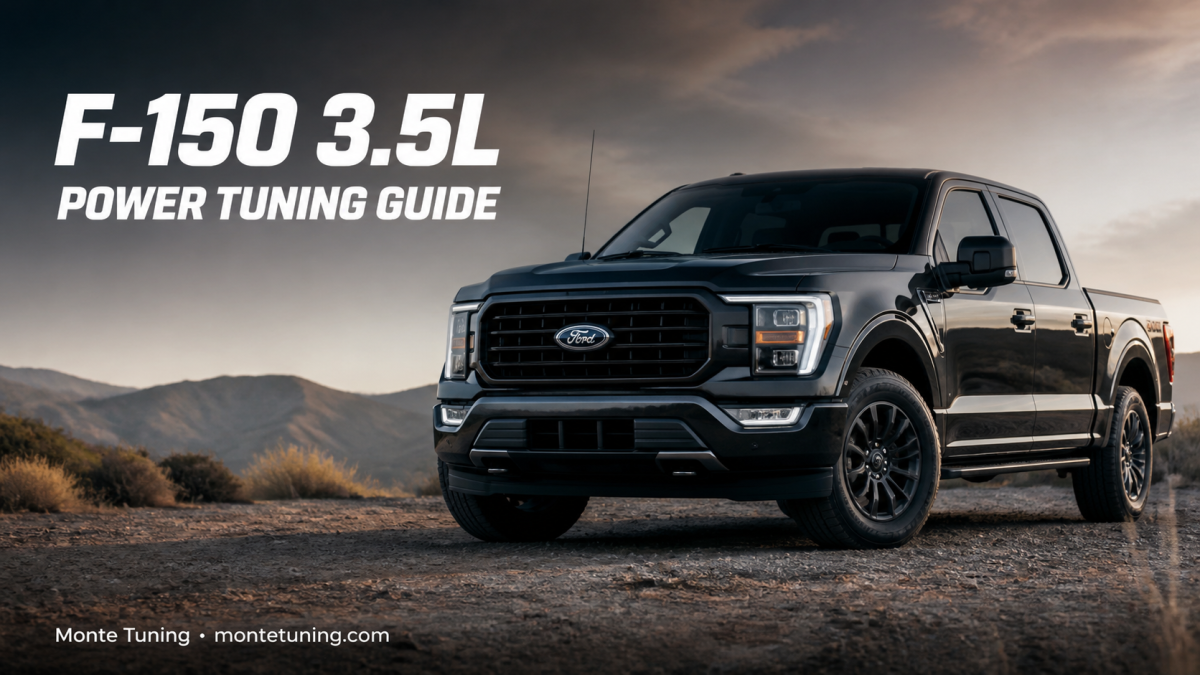
Tuning the Ford F-150 3.5L EcoBoost engine involves using an OBD2 plug-and-play device to safely optimize boost, air-fuel ratios, and throttle response. This approach enhances horsepower and torque while improving fuel efficiency, without requiring permanent ECU modifications or mechanical expertise.
Most F-150 owners eventually reach a point where they want more from their truck. Whether you are towing a heavy trailer through the Rockies or just navigating the stop-and-go commute in a major city, the factory settings often feel a bit muted. The Ford 3.5L EcoBoost is a masterpiece of modern engineering, yet it is intentionally limited by conservative factory parameters designed to satisfy global emissions requirements rather than maximize performance.
When you look into chip tuning Ford trucks, you might feel overwhelmed by the choice between aggressive hardware modifications and software changes. However, the most accessible entry point is through the vehicle’s existing CAN bus network. By plugging a device directly into the OBD2 port, you can unlock hidden potential safely, reversibly, and without the risks often associated with traditional ECU flashing.
Engineering the 3.5L EcoBoost for Performance
The Ford 3.5L V6 EcoBoost is built more like a diesel engine than a standard gasoline motor. With its forged steel, fully counterweighted crankshaft and 6-bolt main bearing caps, the engine block is over-engineered by design. This structural robustness is exactly why it responds so effectively to an increase in boost pressure. Factory boost levels typically hover between 12 and 15 PSI, but the engine internals are capable of handling significantly more when managed correctly.
A high-quality OBD2 tuner works by communicating with the Powertrain Control Module (PCM) to optimize key parameters. Instead of rewriting the factory code, these devices intercept and refine signals in real-time. The result is a more responsive throttle, smoother gear transitions, and, crucially, a noticeable boost in torque exactly where you need it—in the low-to-mid RPM range.
Installation and the Adaptive Drive Cycle
The installation process for modern OBD2 devices is remarkably straightforward. Unlike traditional flash tuning that requires a laptop, special software, and a steady power supply, plug-and-play modules like the Monte GT are designed for the everyday driver.
- Locate the OBD2 port, usually found beneath the dashboard on the driver’s side.
- Connect the tuning device according to the specific instructions provided.
- Start the vehicle and allow it to idle for a few minutes to establish the initial connection.
- Complete an adaptive drive cycle of approximately 50 to 150 miles.
The “learning phase” is vital. During these initial miles, the vehicle’s transmission logic and fuel trims adjust to the new, optimized mapping. It is common to feel the performance gains immediately, but the smoothness of the delivery will improve as the ECU completes its adaptive process.
Every vehicle and engine configuration responds differently to OBD2 tuning. Before purchasing, it’s worth checking compatibility with your specific make, model, year, and engine — and reviewing the setup guide for your device.
Performance Expectations and Real-World Usage
One of the most persistent myths is that increasing boost levels will cause immediate mechanical failure. In reality, automotive engineers have demonstrated that the 3.5L EcoBoost can safely support higher pressures when the air-fuel ratio (AFR) is properly maintained. On a stock vehicle, an OBD2 tune typically provides an additional 40–80 horsepower and 60–100 lb-ft of torque at the wheels.
For owners in Australia, Canada, or the US who frequent higher elevations, the benefits are even more pronounced. Naturally aspirated engines struggle with thin air at altitude, but the turbochargers in an EcoBoost can simply work harder to meet the target boost pressure, effectively negating power loss in the mountains.

Browse all Monte Tuning OBD2 tuners →
Tuning Method Comparison
| Feature | OBD2 Plug-and-Play | Traditional ECU Flash |
|---|---|---|
| Installation | Seconds (Plug and Play) | Minutes (Requires Software/Tools) |
| Reversibility | Instant (Simply Unplug) | Complex (Requires OEM Flash) |
| Warranty Risk | Low (No Flash Counter) | Higher (Permanent ECU Footprint) |
| Best For | Commuters/Tow Vehicles | Heavily Modified Race Trucks |
Why Owners Choose OBD2 Tuning
The primary motivator for many is not just raw power, but consistency and usability. Factory throttle mapping is often programmed with a delay to optimize for emissions testing across diverse global climates. By adjusting this mapping, drivers often find their truck is far easier to control in stop-and-go traffic.
Furthermore, because these devices do not permanently alter the PCM, they remain the preferred choice for those concerned about vehicle warranties. If the truck needs to go to the dealership for routine service, the device can be unplugged in under a minute, leaving the factory software untouched and trace-free. If you are looking for a balance between performance and practicality, exploring the Monte GTR or similar options allows you to tailor your driving experience to your specific needs.
Expected gains, optimal drive cycle duration, and compatibility details vary by vehicle. The Monte GTR support & setup guide and Monte GT support & setup guide walk through setup step by step for each device model.
Check compatibility and explore the full lineup:
montetuning.com —
available for US, CA, UK, AU, and ES. Ships worldwide.
Frequently Asked Questions
Is OBD2 tuning safe for my Ford F-150?
Yes, when using a reputable device, tuning is safe. These devices operate within the engine’s factory safety parameters, ensuring that the air-fuel ratio and ignition timing remain within safe limits for daily driving.
Will this void my vehicle warranty?
Plug-and-play OBD2 devices do not permanently modify the ECU, meaning there is no “flash count” left behind. Since the device can be removed before a dealership visit, it is generally considered the most warranty-friendly tuning method.
Do I need a mechanic to install the tuner?
No mechanic is required. The devices are designed to be plug-and-play, connecting directly to the OBD2 port typically found under the driver-side dash. If you can plug in a standard USB cable, you can install these tuners.
How long until I notice the results?
You will often notice improved throttle response immediately. However, the full benefits—including optimized transmission shift points and fuel efficiency gains—usually become apparent after the 50 to 150-mile adaptive drive cycle.
How does this differ from a full ECU remap?
A full ECU remap (or flash tune) permanently overwrites the vehicle’s original software, which can be detected by dealership scanners. An OBD2 tuner modifies the signals dynamically and leaves the original software entirely intact.