
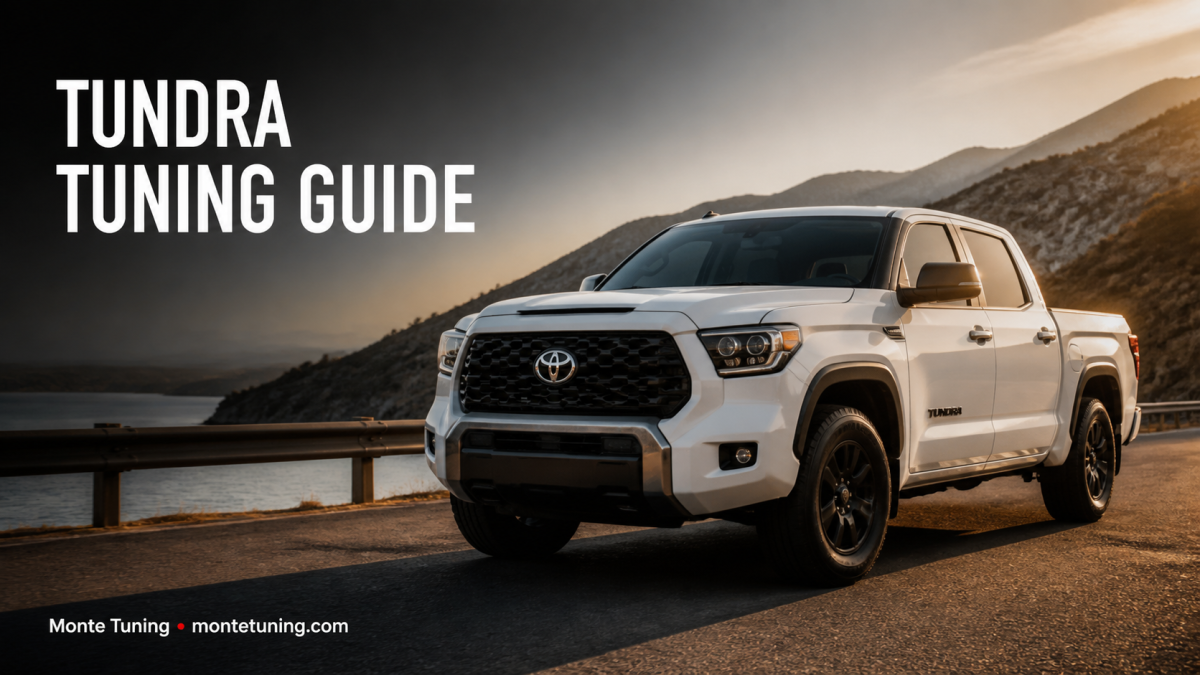
Toyota Tundra tuning is the process of optimizing engine management parameters via OBD2 connectivity to improve horsepower, torque, throttle response, and fuel efficiency. By refining signals for fuel maps, ignition timing, and boost pressure, these devices allow drivers to unlock hidden performance potential without permanent ECU modifications.
There is a distinct feeling when driving a Tundra, whether it is the classic 5.7L V8 or the newer 3.5L twin-turbo V6. Most owners feel it in the pedal—a certain hesitation or a lag that makes the truck feel less responsive than the engine’s capability suggests. While factory settings prioritize extreme conservatism to suit every possible global environment, they often leave a significant margin of performance on the table. Tuning isn’t about pushing an engine beyond its limits; it is about reclaiming the efficiency and power the engineers designed into the platform before the constraints of mass production took hold.
The 5.7L V8 (3UR-FE) Performance Dynamics
The 5.7L V8 remains a favorite for its reliability and linear power delivery. Because it is naturally aspirated, the tuning approach focuses on correcting throttle mapping and optimizing mid-range torque. Many enthusiasts mistakenly search for massive peak horsepower gains, but the real-world benefit of toyota tundra тюнинг on this engine is found in the area under the curve.
- Throttle Response: OBD2 tuning removes the factory-programmed delay, making the pedal feel more connected to the engine.
- Mid-Range Torque: Significant gains in the 3,000 RPM range assist with towing and highway passing.
- Efficiency: Optimized fuel trims can lead to modest improvements in MPG during steady-state cruising.
Critics often argue that naturally aspirated engines cannot be tuned effectively. This misses the point of modern signal optimization. While you are not adding a turbocharger, you are allowing the existing hardware to operate with fewer artificial restrictions, which transforms the driving experience from sluggish to eager.
The 3.5L Twin-Turbo V6 (V35A-FTS)
The introduction of the 3.5L twin-turbo engine shifted the toyota tundra тюнинг landscape entirely. Forced induction engines are inherently more responsive to timing and boost adjustments. In this platform, an OBD2 tuner can safely command precise increases in boost pressure alongside optimized fueling, often resulting in substantial improvements in both horsepower and torque at the wheels.
Given the complexity of modern ECU encryption, a plug-and-play approach is often the only safe route. These devices work downstream of the factory logic, retaining all OEM safety sensors and thermal protections. Because the system does not rewrite the factory ROM, it remains immune to Over-The-Air (OTA) updates that often wipe out traditional flash tunes.
Installation and the Importance of the Drive Cycle
Modern plug-and-play tuning is designed for the DIY enthusiast. The process generally involves connecting a device to the OBD2 port, which allows the hardware to communicate with the ECU in real time. However, immediate results are only the beginning.
- Installation: Plug the device into the OBD2 port, typically located under the dashboard.
- Initialization: Allow the system to handshake with the ECU.
- The Drive Cycle: The vehicle requires approximately 50 to 100 miles of varied driving to adapt fuel trims and shift mapping to the new, optimized signals.
Every vehicle and engine configuration responds differently to OBD2 tuning. Before purchasing, it’s worth checking compatibility with your specific make, model, year, and engine — and reviewing the setup guide for your device. For those using the Monte GT, refer to the Monte GT setup guide, or for the Monte GTR, consult the Monte GTR setup guide.

Browse all Monte Tuning OBD2 tuners →
Comparison of Tuning Approaches
| Feature | OBD2 Plug-and-Play | Traditional ECU Flash |
|---|---|---|
| Installation | DIY, simple connection | Professional, permanent |
| Reversibility | Fully reversible | Often permanent |
| Warranty Risk | Low (no ECU footprint) | High (flash counter) |
| Impact of OTA Updates | None | Potential to wipe tune |
Legal, Warranty, and Safety Considerations
The primary concern for many owners is the impact on vehicle warranties. Under legislation like the Magnuson-Moss Warranty Act, manufacturers must generally prove that an aftermarket modification directly caused a failure to deny a warranty claim. Because plug-and-play modules do not permanently alter the ECU code or leave a “flash counter” footprint, they are significantly safer from a warranty perspective than a full remap.
Expected gains, optimal drive cycle duration, and compatibility details vary by vehicle. The Monte Tuning support guides walk through setup step by step for each device model.
Enhancing Your Tundra Experience
Whether you are looking to sharpen the throttle response of your 5.7L or unlock the forced-induction potential of the 3.5L, toyota tundra тюнинг is about making the truck perform the way you expect it to. The Monte GT and Monte GTR were developed to provide a reliable bridge between factory settings and optimized engine performance. To learn more about our engineering philosophy, you can read about Monte Tuning.
Check compatibility and explore the full lineup: montetuning.com — available for US, CA, UK, AU, and ES. Ships worldwide.
Frequently Asked Questions
Is OBD2 tuning safe for my Toyota Tundra?
Yes, professional OBD2 tuners operate within the factory safety parameters, ensuring that knock sensors and thermal protections remain fully active to protect your powertrain.
Will a plug-and-play tuner void my factory warranty?
Because these devices are fully reversible and do not leave a permanent ECU footprint, they significantly lower the risk compared to traditional, permanent ECU remapping.
How long until I notice results?
You will typically notice improved throttle response immediately. However, the full adjustment to fuel trims and shifting occurs after a standard drive cycle of 50 to 100 miles.
Do I need a mechanic to install the tuner?
No, these devices are designed for simple, DIY installation. No tools or specialized mechanical knowledge are required.
How does this differ from a full ECU remap?
A remap permanently overwrites your factory software and is often detectable by dealer diagnostic equipment. A plug-and-play tuner optimizes signals in real time and can be removed in seconds without leaving a trace.