
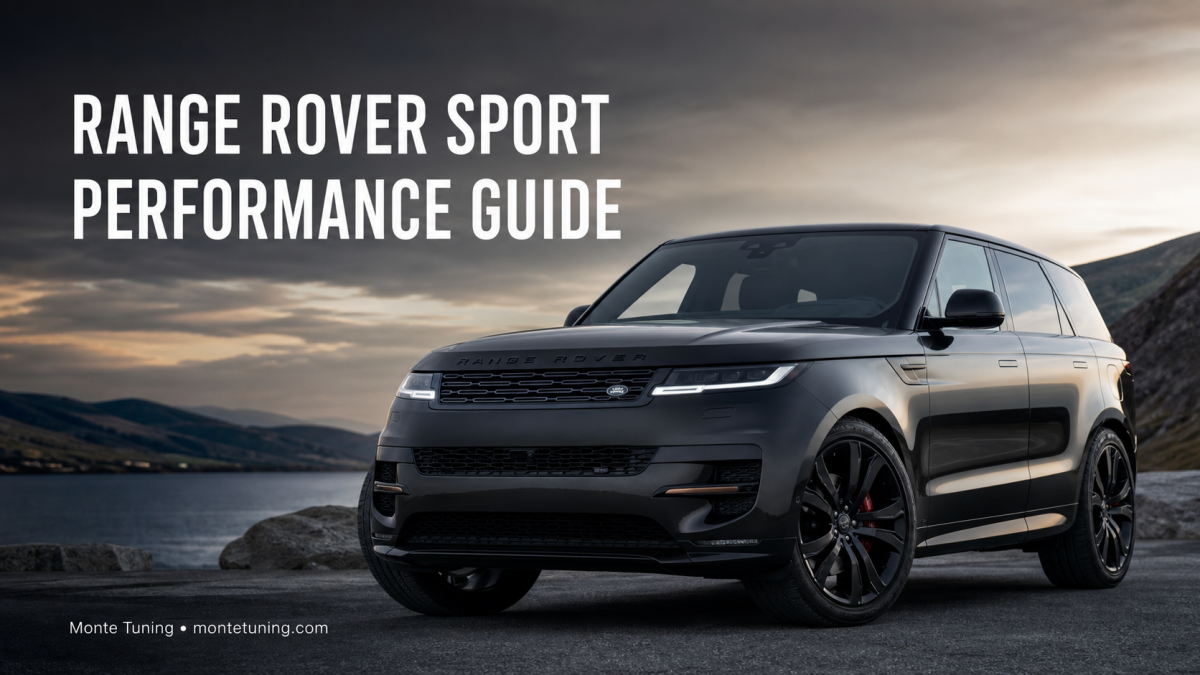
Range Rover Sport tuning is the process of optimizing engine management parameters via the OBD2 port to improve throttle response, torque delivery, and fuel efficiency. For the 5.0L V8 and D300 MHEV engines, this approach enhances performance without permanent ECU modification or voiding complex factory diagnostics.
Driving a Range Rover Sport, whether it is the raw power of the 5.0L V8 Supercharged or the refined efficiency of the D300, often leaves enthusiasts wanting more. Manufacturers calibrate these engines for global markets, prioritizing conservative emissions targets and varied fuel quality over pure driving dynamics. This often leads to that familiar hesitation when you step on the pedal—a disconnect between your intent and the engine’s response.
For many owners, the hesitation is not a mechanical failure but a result of software-level limitations. Getting more from your vehicle does not necessarily mean visiting a mechanic or risking your warranty with permanent ECU overwrites. Understanding how modern OBD2 tuning interacts with the CAN bus network can unlock a more responsive driving experience.
Engineering Performance in the 5.0L V8 and D300
The 5.0L V8 AJ133 engine and the 3.0L D300 mild-hybrid diesel operate under highly sophisticated management systems. When we discuss range rover sport тюнинг, we are essentially talking about reclaiming latent performance that is already present in the hardware.
How OBD2 Optimization Works
Unlike traditional flash remapping, which overwrites the vehicle’s base software, plug-and-play devices function as intelligent intermediaries. They communicate with the engine control unit via the OBD2 port, modifying sensor signals like manifold absolute pressure and fuel rail pressure in real-time. This allows the engine to operate closer to its optimal efficiency window without triggering fault codes or exceeding safety limits.
The D300 MHEV Advantage
The D300 presents a unique opportunity for чип тюнинг range rover дизель. Because this engine is part of a 48V mild-hybrid system, the tuning goal is often twofold: reducing turbo lag and optimizing torque delivery for better fuel efficiency during cruising. By refining injection timing and VGT (variable geometry turbo) mapping, you can achieve a smoother power delivery that makes the vehicle feel significantly lighter and more agile.
Every vehicle and engine configuration responds differently to OBD2 tuning. Before purchasing, it’s worth checking compatibility with your specific make, model, year, and engine — and reviewing the setup guide for your device.
Understanding the Tuning Landscape
The aftermarket tuning sector is shifting away from invasive methods. As JLR integrates tighter security and Software-Over-The-Air (SOTA) updates, traditional remaps are becoming increasingly fragile, often being wiped clean during a routine dealership service. OBD2 modules provide a reliable alternative because they remain external to the ECU’s core software.

Browse all Monte Tuning OBD2 tuners →
Comparison of Tuning Approaches
| Feature | OBD2 Module Tuning | Traditional ECU Remap |
|---|---|---|
| Installation | Plug-and-play | Bench flash / Software overwrite |
| Reversibility | Instant (unplug) | Difficult (requires factory restore) |
| Dealer Updates | Unaffected | Risk of being overwritten |
| Warranty Safety | Low risk (non-destructive) | High risk (CVN tracking) |
Implementation and Real-World Results
Successful tuning relies on the health of your vehicle. Before installing any device, ensure your battery is in good condition and that the engine is free of pre-existing faults. Once connected, the ECU requires a brief learning phase, or drive cycle. Over 50 to 150 miles, the engine management system adapts to the new parameters, smoothing out gear shifts and refining throttle mapping.
Expected gains, optimal drive cycle duration, and compatibility details vary by vehicle. The Monte GT setup guide and Monte GTR setup guide walk through setup step by step for each device model.
Who Benefits Most from OBD2 Tuning?
Those who value their vehicle’s long-term reliability but want to eliminate the factory sluggishness often find these devices to be the ideal solution. Whether you are looking for more confidence when towing with your D300 or a more immediate connection to your 5.0L V8, the focus is on a balanced performance increase.
If you are exploring the range rover l322 тюнинг or upgrading a modern sport model, the goal remains the same: optimizing existing potential. About Monte Tuning is a great place to start understanding the design philosophy behind our modules. The Monte GT is frequently chosen for balanced, everyday improvements, while those seeking a more pronounced adjustment often look toward the Monte GTR.
Check compatibility and explore the full lineup: montetuning.com — available for US, CA, UK, AU, and ES. Ships worldwide.
Frequently Asked Questions
Is OBD2 tuning safe for my Range Rover Sport?
Yes. Quality OBD2 modules operate within the manufacturer’s pre-defined safety tolerances. They do not override factory “limp mode” or critical safety monitors, meaning your engine protection systems remain fully active.
Will this void my vehicle warranty?
Because these devices are non-destructive and do not alter the ECU’s internal calibration verification number, they are fundamentally different from flashing software. They are easily removed before dealer visits, leaving no permanent trace.
Do I need a mechanic for installation?
No. These devices are designed for owner-installation. The process involves connecting the unit to the existing OBD2 port, typically located under the dashboard, which requires no specialized tools or technical expertise.
How long until I notice a difference in performance?
While some changes in throttle response are immediate, the engine’s ECU typically requires a drive cycle of 50 to 150 miles to fully adapt its fuel trims and timing to the new data, ensuring the smoothest power delivery.
Can this help with fuel economy?
Yes, particularly for diesel engines. By optimizing torque delivery, you can often maintain speed with less throttle input, which may lead to improved fuel efficiency in real-world driving conditions.