
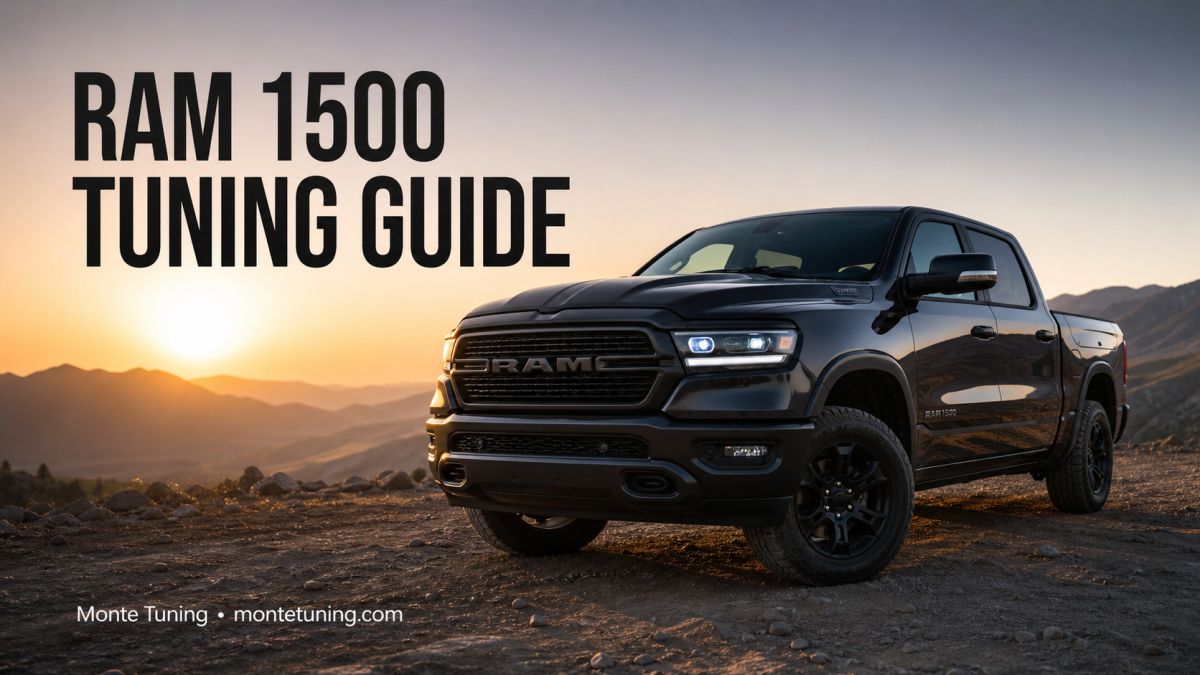
RAM 1500 tuning involves optimizing the Engine Control Unit (ECU) parameters via the OBD2 port to improve throttle response, torque delivery, and fuel efficiency. By using plug-and-play modules, owners can enhance vehicle performance without permanent software changes, making the process safe, reversible, and accessible for daily driving or towing.
There is a specific feeling every RAM 1500 owner knows—the slight hesitation when pressing the pedal to merge onto a highway or the feeling of the engine hunting for the right gear while pulling a trailer. For many, this is just accepted as factory behavior. However, the modern approach to vehicle optimization has shifted away from complex, irreversible modifications toward smart, non-intrusive electronic adjustments that work with the truck’s existing architecture rather than fighting against it.
Whether you are piloting the reliable 5.7L Hemi or the torque-heavy EcoDiesel, the goal of tuning is not to push the engine past its breaking point. Instead, it is about refining how the truck manages air, fuel, and timing to better suit your driving style. This guide focuses on how plug-and-play OBD2 technology bridges the gap between stock performance and a more responsive, efficient machine.
Understanding OBD2 Tuning for RAM 1500
Modern Engine Control Units are sophisticated computers that manage hundreds of variables in real-time. A Monte GT or similar OBD2 module does not overwrite your factory files. Instead, it processes data signals dynamically. Think of it as an interpreter between your driving input and the engine’s response, smoothing out the factory “dips” in power that manufacturers program for broad, conservative fleet averages.
EcoDiesel vs. 5.7L Hemi: Different Approaches
The tuning requirements for the RAM 1500 hemi are distinct from those of the diesel variant. The 5.7L Hemi is naturally aspirated, meaning it lacks a turbocharger to “boost” at the command of the computer. Tuning here is centered on ignition timing and throttle mapping. By sharpening the throttle response, you eliminate that familiar factory lag, making the truck feel lighter and more agile in city traffic.
The 3.0L EcoDiesel operates on a different set of rules. Because it is a forced-induction engine, tuning modules can influence turbo boost limits and fuel injection timing more directly. This typically results in a more pronounced increase in low-end torque—the kind that makes towing heavy loads feel less like a chore and more like a standard commute.
Every vehicle and engine configuration responds differently to OBD2 tuning. Before purchasing, it’s worth checking compatibility with your specific make, model, year, and engine — and reviewing the setup guide for your device.
The Essential Role of the Security Gateway Module
If you own a 2018 or newer RAM 1500, you have likely encountered the Security Gateway (SGW) module. Stellantis implemented this as a digital firewall to protect the vehicle’s network from unauthorized communication. If you attempt to connect an OBD2 device without addressing this, the tuner will effectively be blocked from seeing the vehicle’s data.
To perform any meaningful ram 1500 тюнинг, you must use an SGW bypass or a 12+8 pin cable. This simple adapter, usually tucked behind the instrument cluster or the center console, creates a bridge, allowing your tuning device to communicate freely with the ECU. Once the bypass is in place, the installation becomes a true plug-and-play experience, requiring no special tools or mechanical expertise.
Comparison of Tuning Approaches
| Feature | Plug-and-Play OBD2 | Bench Flash / Custom Tune |
|---|---|---|
| Installation | Simple, Port-Based | Advanced, ECU Removal |
| Permanence | Reversible (Instant) | Permanent (Requires Restore) |
| Warranty Friendly | High (Leaves no trace) | Low (May flag dealer scan) |
| Typical Focus | Throttle, Efficiency, Curve | Aggressive Peak Power |
| Best For | Daily Drivers, Towing | Modified Engines, Track |

Browse all Monte Tuning OBD2 tuners →
Getting More from Your RAM 1500
The primary benefit of a device like the Monte GTR is the refinement of the drive cycle. When you first plug in a tuner, the engine does not instantly change its personality; it needs a period—typically 50 to 150 miles—to adapt to the new, optimized signals. During this phase, the ECU adjusts its fuel trims to harmonize with the updated input, which is where many owners begin to notice improved highway efficiency and smoother transmission shift points.
Common Misconceptions
There is a persistent myth that a simple module can add 100+ horsepower to a naturally aspirated 5.7L Hemi. In reality, engine power is physically limited by airflow and mechanical tolerances. Respectable tuning focuses on optimizing the curve—delivering the power you already have more effectively and removing the artificial constraints placed on the engine from the factory. If a claim sounds too good to be true, it likely is.
Sustainability and Maintenance
Tuning is most effective when the vehicle is in good mechanical health. Before upgrading, ensure your air filters are clean and your spark plugs are within service intervals. For EcoDiesel owners, a healthy DPF and EGR system is vital for optimal performance. Treating your RAM 1500 with proper maintenance ensures that the tuning device has a stable baseline to improve upon, rather than attempting to compensate for worn-out hardware.
Why Choose Monte Tuning for Your RAM
We believe that performance should not come at the cost of reliability or convenience. Our approach with the Monte GT and Monte GTR is to provide the enthusiast with a tool that respects the factory design. By learning about Monte Tuning, you will see that our focus is on building smarter, adaptive devices that work with the car’s computer, not against it.
If you are looking to improve your fuel economy, sharpen your throttle, or get more out of your towing setup, our Monte GT setup guide and Monte GTR setup guide provide clear, step-by-step instructions to get you up and running quickly. We prioritize transparency, safety, and a straightforward user experience for every driver.
Check compatibility and explore the full lineup:
montetuning.com —
available for US, CA, UK, AU, and ES. Ships worldwide.
Frequently Asked Questions
Is OBD2 tuning safe for my RAM 1500?
Yes, because plug-and-play modules like the Monte GT operate within the factory safety parameters, they do not push the engine beyond its design limits.
Will this void my factory warranty?
Because these devices do not permanently modify the ECU or overwrite the original software, they are generally one of the most warranty-friendly performance upgrades available.
How long until I notice a difference in performance?
After installation, the ECU typically requires a drive cycle of 50 to 150 miles to adapt to the new optimized signals and deliver consistent improvements in throttle response.
Can I remove the tuner if I need to?
Absolutely. The primary advantage of a plug-and-play module is that it is fully reversible. Simply unplug the device, and your RAM 1500 reverts to its original factory settings immediately.
Do I need a mechanic for installation?
Not at all. The installation is designed for DIY enthusiasts. On 2018+ models, you only need to install an SGW bypass, which is a simple plug-in component, followed by connecting the tuner to the OBD2 port.
How does this differ from a full ECU remap?
A full remap (bench flash) permanently overwrites the ECU software, which is difficult to reverse and often detectable by dealerships. OBD2 tuning is a dynamic, non-permanent, and safer alternative for most daily drivers.