
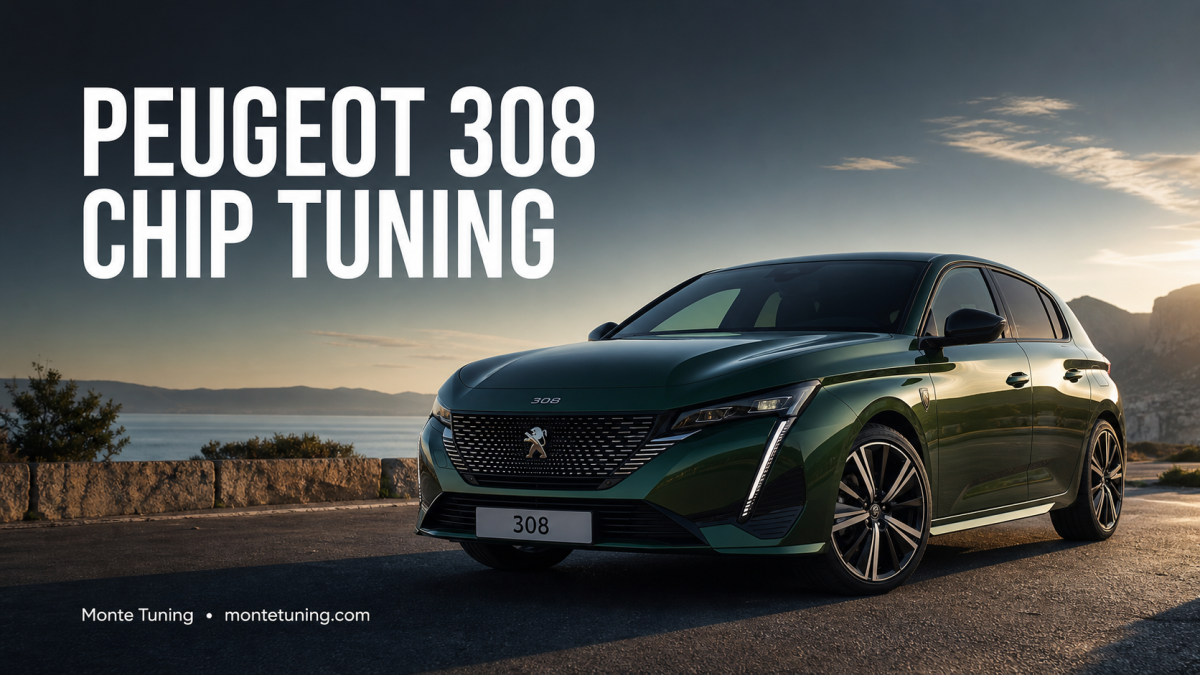
Peugeot 308 chip tuning involves connecting a dedicated OBD2 device to the vehicle’s diagnostic port to optimize engine parameters like boost pressure and ignition timing. This process enhances throttle response, increases torque and horsepower, and improves fuel efficiency without requiring permanent modifications to the factory ECU software.
Driving a modern vehicle often feels like a compromise between environmental compliance and raw performance. The Peugeot 308, particularly with the 1.2 PureTech and 1.6 THP engines, is a prime example of this. Engineers design these engines to handle everything from harsh winters in Canada to stop-and-go traffic in the UK, leading to factory settings that prioritize broad safety margins over responsiveness. For owners, this often manifests as a sluggish pedal feel or a lack of pull when passing on the highway.
Performance tuning has evolved significantly. Years ago, unlocking power meant visiting a specialized shop to physically open the ECU or risk permanent software changes. Today, modern plug-and-play modules offer a more balanced approach for everyday drivers. Whether you are looking to sharpen the throttle response of your 1.2-liter hatch or smooth out the power delivery in your 1.6-liter model, understanding how your vehicle manages its air-fuel mixtures is the first step toward getting more from your daily drive.
Understanding ECU Calibration for Peugeot Engines
Modern Peugeot engines rely on complex electronic management. The factory ECU maintains control over engine load, fuel injection, and turbocharger boost. When you install an OBD2 tuning module, you are not overwriting the car’s primary software. Instead, you are providing the engine with refined operating parameters that sit within the manufacturer’s established safety limits.
The 1.2 PureTech engine, with its 3-cylinder configuration, benefits greatly from optimized boost management. By refining how the turbocharger engages, you can significantly reduce low-end lag. The 1.6 THP (Prince engine), often found in higher-spec trims, responds well to ignition timing adjustments, which helps flatten the torque curve and makes the vehicle feel more agile during mid-range acceleration.
Every vehicle and engine configuration responds differently to OBD2 tuning. Before purchasing, it’s worth checking compatibility with your specific make, model, year, and engine — and reviewing the setup guide for your device.
Installation and the Drive Cycle
One of the primary advantages of this approach is simplicity. There is no need for a mechanic; the process is designed for the owner to perform in minutes. After connecting the device to the OBD2 port, the car requires a period of adjustment. This is known as a drive cycle, during which the ECU learns the new, optimized parameters through its Long-Term Fuel Trims (LTFT).
It typically takes 50 to 100 miles of varied driving for these settings to stabilize. During this time, the car adapts to the new instructions while continuing to monitor sensor data for safety. If at any point the engine detects an anomaly—such as a failing ignition coil or old spark plugs—the system will immediately revert to stock behavior, ensuring the engine remains protected.

Browse all Monte Tuning OBD2 tuners →
Performance Expectations by Engine Type
While results vary based on fuel quality, maintenance, and specific engine health, there are general performance trends observed in the field for Peugeot 308 variants.
| Engine Type | Performance Focus | Typical Adjustment Effect |
|---|---|---|
| 1.2 PureTech | Throttle Response & MPG | Reduced lag, smoother urban driving |
| 1.6 THP | Torque & Mid-range Pull | Flattened curve, stronger overtaking |
Expected gains, optimal drive cycle duration, and compatibility details vary by vehicle. The Monte GT setup guide and Monte GTR setup guide walk through setup step by step for each device model.
Maintenance and Compatibility
Before adding any performance enhancement, your car must be in good working order. For the 1.2 PureTech, verify the integrity of the wet timing belt and ensure you are using the correct, fresh oil. For the 1.6 THP, check for carbon buildup on intake valves, as direct-injection engines can be sensitive to this. If you are experiencing existing sensor errors or ignition misfires, resolve those hardware issues first. Tuning should always be applied to a healthy engine to see the best results.
Why Drivers Choose Plug-and-Play Solutions
Many owners choose this route because they want more performance without the commitment of a permanent remap. Whether you are in the US, CA, UK, AU, or ES, your driving environment dictates your needs—be it fuel economy on long commutes or extra torque for mountainous roads. By using a device like the Monte GT or the Monte GTR, you maintain the ability to remove the hardware at any time, restoring the vehicle to its original factory configuration instantly. This provides peace of mind, especially for those concerned about warranty considerations or trade-in values.
Check compatibility and explore the full lineup: montetuning.com — available for US, CA, UK, AU, and ES. Ships worldwide.
Frequently Asked Questions
Is OBD2 tuning safe for my Peugeot 308?
Yes. Modern OBD2 tuners work within the factory’s established safety protocols. If the ECU detects any parameter outside of safe operation, the device ceases to intervene, allowing the car to operate in its stock, factory-safe mode.
Will this void my vehicle warranty?
Plug-and-play devices are designed to be reversible. Because they do not permanently overwrite the ECU’s firmware, removing the device before a dealer visit leaves no digital footprint of the modification, unlike bench remapping.
Do I need a mechanic to install the tuner?
No. Installation is a straightforward process that involves plugging the device into the vehicle’s OBD2 port, typically located under the dashboard. No special tools or mechanical expertise are required.
How long until I notice a difference?
While some drivers report immediate changes in throttle response, the full performance and efficiency benefits usually stabilize after a drive cycle of 50 to 100 miles as the ECU adjusts its fuel trims.
How does this differ from a full ECU remap?
A full remap overwrites the permanent software on your ECU. An OBD2 tuner is a dynamic, plug-and-play solution that adjusts data in real-time. It is non-permanent, easily reversible, and does not trigger flash counters that can be flagged by dealership diagnostic equipment.