
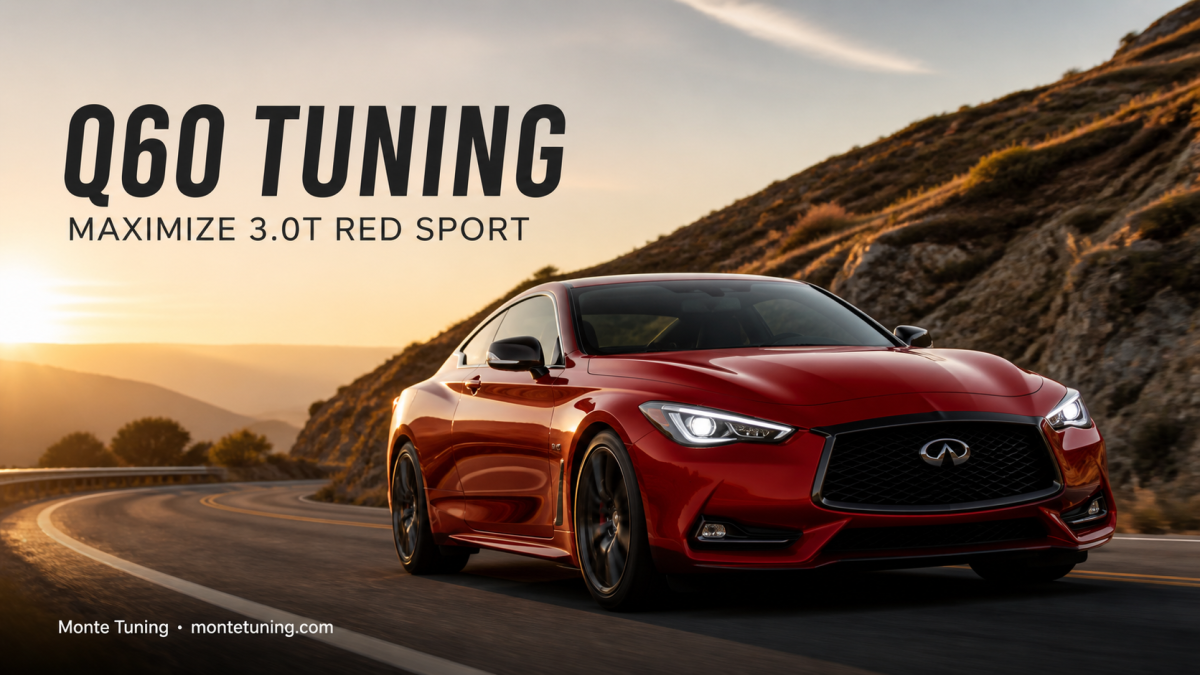
Infiniti Q60 ECU tuning involves using OBD2-based calibration devices to optimize engine parameters, which safely improves horsepower, torque, and throttle response by adjusting sensor data in real-time without permanently overwriting the vehicle’s factory software.
The Infiniti Q60 Red Sport is a curious machine. On paper, the VR30DDTT engine is a powerhouse, yet many owners feel that the factory tuning is surprisingly conservative, often dampening the car’s true potential to meet broad global emission and fuel standards. If you are an enthusiast who wants to wake up the 3.0T without diving into complex mechanical modifications or risking a permanent ECU reflash, you are likely looking at OBD2 performance tuning.
There is a distinct difference between “tuning for numbers” and “tuning for the driving experience.” While internet forums often focus on peak dyno figures, real-world performance is about how the car delivers power when you are merging onto a highway or navigating a mountain pass. The modern approach focuses on maximizing efficiency and responsiveness within the safety margins engineered by Infiniti, rather than pushing the engine to its breaking point.
The Mechanics of VR30DDTT Tuning
The VR30DDTT engine is a sophisticated piece of engineering, utilizing electronic wastegates and direct injection. Because it is a turbocharged platform, the ECU is constantly reading data from manifold absolute pressure (MAP) and mass airflow (MAF) sensors to determine boost targets and air-fuel ratios.
A plug-and-play OBD2 tuner, such as the Monte GTR, works by intercepting these signals. Rather than forcing the ECU to overwrite its base ROM, the device provides supplemental data that encourages the engine management system to operate at a higher performance profile. This is why the method is so effective for owners who want a performance boost while keeping the factory safety systems—like knock detection and limp mode—fully operational.
Every vehicle and engine configuration responds differently to OBD2 tuning. Before purchasing, it’s worth checking compatibility with your specific make, model, year, and engine — and reviewing the setup guide for your device.
Performance Expectations and Real-World Results
While marketing materials often promise massive, arbitrary numbers, the reality is that gains depend on fuel quality, atmospheric conditions, and the health of your engine. On a healthy 3.0T Red Sport running 93 octane, you can expect a more linear torque curve and improved throttle sensitivity. This does not just make the car faster; it makes it more predictable.
Many owners ask about fuel economy. Because a tuned engine can operate more efficiently by optimizing ignition timing and turbo spooling, some drivers notice improved MPG during steady-state highway cruising. However, this depends entirely on your right foot.
| Feature | OBD2 Plug-and-Play | Traditional Flash Remap |
|---|---|---|
| Installation | No tools required | Professional equipment |
| Reversibility | 100% (Instant) | Complex / Digital footprint |
| OTA Update Safety | Immune | Often overwritten |
| Hardware Impact | Minimal | High |
For those interested in the technical installation, the Monte GTR setup guide provides a clear look at how these devices interface with the Q60’s CAN bus system, ensuring that the integration is seamless.
Common Misconceptions
There is a lingering myth that any tuning automatically voids a manufacturer warranty. In the United States, legislation like the Magnuson-Moss Warranty Act protects consumers, and the burden of proof lies with the manufacturer to show that a specific modification caused a failure. Because plug-and-play devices are reversible, they leave no permanent “flash counter” in the ECU, which is the primary footprint dealerships look for during service visits.
Another common mistake is neglecting maintenance before tuning. If your spark plugs are worn or your ignition coils are weak, increased boost will reveal these issues immediately, often resulting in engine hesitation. Think of a tune as a multiplier: if your baseline engine health is 100%, the tune multiplies that performance. If your baseline is 70% due to poor maintenance, you will likely encounter performance stutters.

Browse all Monte Tuning OBD2 tuners →
Why Opt for Plug-and-Play Solutions?
The transition toward non-permanent, intelligent tuning has been driven by the increasing complexity of modern car software. With manufacturers issuing frequent Over-the-Air (OTA) updates, a traditional flash tune can be wiped out overnight by a dealership’s software refresh. An external module like the Monte GT operates independently, meaning your performance gains stay intact regardless of what the factory pushes to the vehicle’s primary ECU.
Beyond the Q60, we often see interest in broader platform performance, such as chip тюнинг инфинити qx70 or chip тюнинг инфинити фх35 models. While the engine platforms differ, the philosophy remains the same: extracting hidden efficiency and responsiveness through smart, non-invasive calibration. Whether you are driving a legacy model or a modern twin-turbo coupe, the goal is a more engaging drive without the headache of invasive, permanent modifications.
Check compatibility and explore the full lineup:
montetuning.com — available for US, CA, UK, AU, and ES. Ships worldwide.
Frequently Asked Questions
Is OBD2 tuning safe for the engine?
Yes, when using a reputable device that works within the factory ECU’s safety parameters. A proper tune does not bypass the engine’s built-in protection logic, such as knock control or heat management.
Will this void my factory warranty?
Plug-and-play devices are designed to be undetectable once removed. Because they do not permanently modify the ECU software, there is no flash counter for a dealership to detect during a routine service.
Do I need a mechanic for installation?
No. These devices are designed for plug-and-play installation. The Monte GT setup guide covers the simple process of connecting the unit, which can be done by the owner in minutes.
How long until I notice the difference?
Most drivers feel a difference in throttle response immediately. Full calibration adjustments typically finish during a brief drive cycle of 30 to 50 miles of mixed driving.
How does this differ from a full ECU remap?
A full remap (flashing) rewrites the internal code of the ECU, which is permanent and often voids warranties. OBD2 tuning is external, reversible, and does not alter the underlying factory software.