
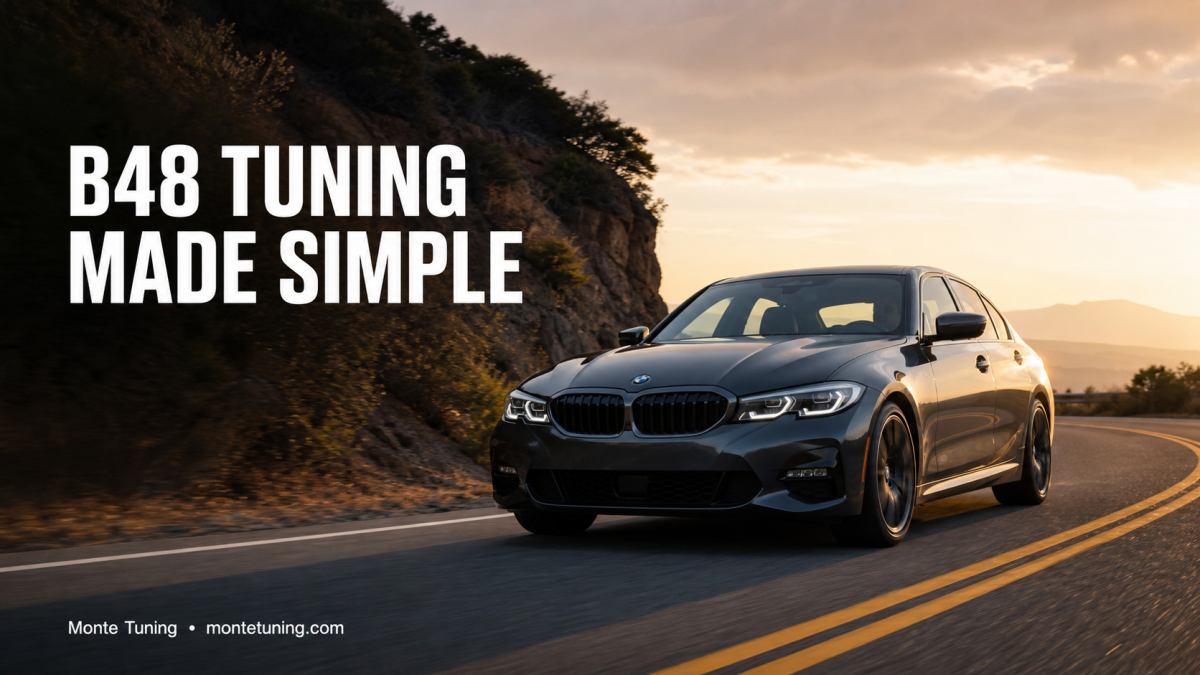
BMW B48 chip tuning is the process of using an OBD2-based module to intercept and optimize sensor signals in real-time, which safely improves horsepower, torque, and throttle response without permanently modifying the engine control unit or requiring a mechanic for installation.
The Modern Approach to B48 Performance
The BMW B48 engine, found in everything from the 330i to various MINI and Toyota models, is a prime candidate for performance optimization. Its closed-deck block and robust internals mean it is often restricted more by factory software maps than by mechanical limits. For many owners, the goal is not to turn their daily driver into a track car, but rather to unlock the latent efficiency and responsiveness that the manufacturer left on the table for broader market appeal.
Historically, achieving this required flash tuning, which involves overwriting the vehicle’s original software. While effective, this carries risks, including the potential to void warranties or brick the ECU during the process. Today, many enthusiasts are moving toward OBD2 tuning because it offers a non-invasive way to sharpen the engine’s character while remaining completely reversible.
5 Steps to Better Performance for the BMW B48
Achieving a reliable performance boost requires a systematic approach. By focusing on maintenance and proper calibration, you ensure that the engine operates smoothly under the new performance parameters.
- Vehicle Health Check: Before applying any tuning, ensure your B48 is in top condition. Inspect your spark plugs and ignition coils, as increased boost pressure can expose weak points in the ignition system. If you notice hesitation at stock levels, address those mechanical issues first.
- Fuel Selection: Tuning optimization relies heavily on ignition timing, which is limited by fuel quality. Use high-octane fuel (91/93 US or 98 RON in Europe/UK/AU) to prevent premature detonation and allow the engine to take full advantage of the optimized air-fuel ratios.
- Plug-and-Play Installation: Modern modules, such as the Monte GT or the more advanced Monte GTR, connect directly to the OBD2 port. These devices are designed to enter sleep mode when the engine is off to prevent parasitic battery drain.
- Drive Cycle Adaptation: After installation, the vehicle does not reach its full potential immediately. The ECU requires an adaptation period, typically 50 to 100 miles of varied driving, to adjust its long-term fuel trims and ignition maps to the new signal data.
- Performance Monitoring: Once adapted, you should feel improved mid-range pull and reduced turbo lag. If you experience uneven acceleration, re-check your ignition components or review the Monte GT setup guide to ensure all connections are secure.
Every vehicle and engine configuration responds differently to OBD2 tuning. Before purchasing, it’s worth checking compatibility with your specific make, model, year, and engine — and reviewing the setup guide for your device.
Comparison of Tuning Approaches
| Feature | OBD2 Piggyback (Monte Tuning) | Traditional Flash Tuning |
|---|---|---|
| Installation | Plug-and-play; DIY | Requires specialized equipment |
| Reversibility | Fully removable; leaves no trace | Often leaves a permanent counter |
| Warranty Impact | Minimal (removable) | Higher risk; often detected |
| Best For | Daily drivers; stock/mild mods | Extensive hardware modifications |
Expected gains, optimal drive cycle duration, and compatibility details vary by vehicle. The Monte GTR setup guide and other resources walk through setup step by step for each device model.

Browse all Monte Tuning OBD2 tuners →
Optimizing the B48 Experience
Drivers choose OBD2 solutions because they value a balance between performance and practicality. Whether you are looking to eliminate the lag inherent in modern throttle-by-wire systems or simply want more torque for safer highway passing, an optimized engine map makes a noticeable difference. What I mean is, you aren’t changing the car’s DNA; you are simply helping it run more efficiently within its intended design parameters.
The Monte GT is often favored by those looking for an immediate improvement in daily drivability, while the Monte GTR provides a more granular approach for enthusiasts who want to maximize the responsiveness of their B48 motor. You can learn more about our engineering philosophy by reading about Monte Tuning.
Check compatibility and explore the full lineup:
montetuning.com —
available for US, CA, UK, AU, and ES. Ships worldwide.
Frequently Asked Questions
Is OBD2 tuning safe for my B48 engine?
Yes. Because these devices work in conjunction with the factory ECU, all OEM safety parameters like knock detection and limp-mode protection remain fully active, protecting the engine from dangerous conditions.
Will this void my vehicle warranty?
In many regions, including the US, manufacturers must prove that an aftermarket part caused a failure to deny a warranty claim. However, because our devices are non-permanent and leave no trace when removed, they are the most discreet method of tuning.
Do I need a mechanic to install the device?
Not at all. The design philosophy behind our tuners is ease of use. If you can locate the OBD2 port under your dashboard, you can install the device in minutes.
How long until I notice the results?
You will often notice improved throttle response immediately, but for the ECU to fully adapt to the new power curves and fuel trims, we recommend a drive cycle of 50 to 100 miles.
Does this affect my emissions compliance?
No. Our devices optimize the performance of the engine without disabling, removing, or modifying any emissions control hardware such as catalytic converters or oxygen sensors.