
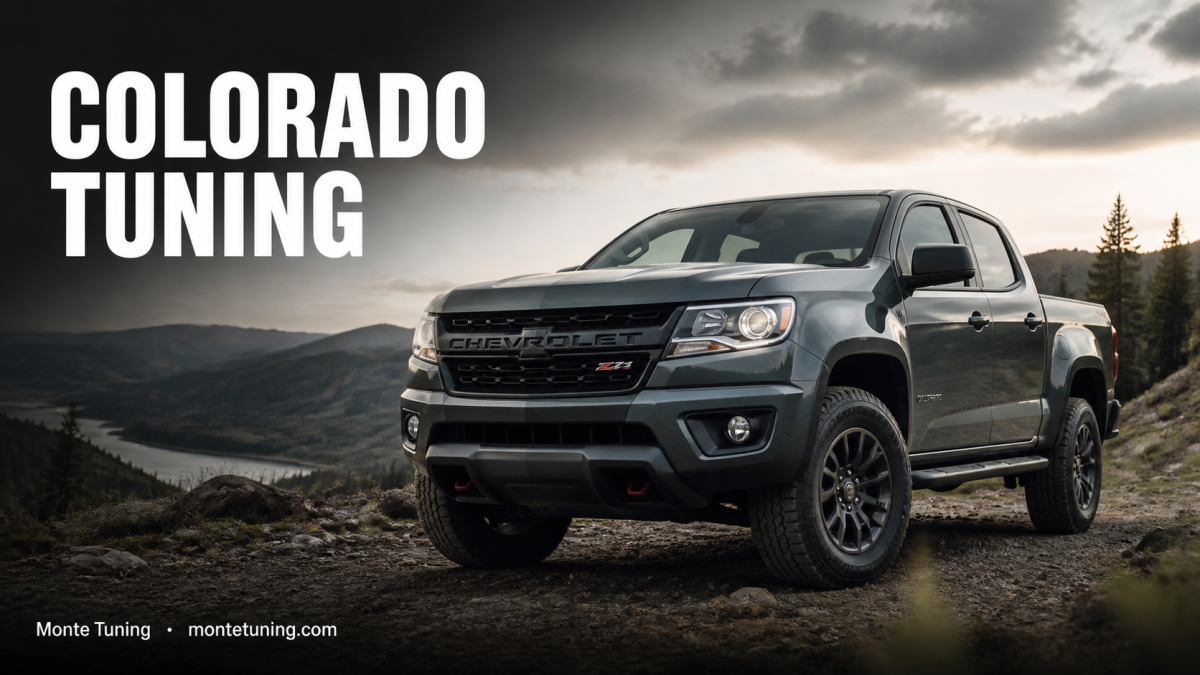
Chevy Colorado tuning is the process of optimizing engine management signals via the OBD2 port to enhance throttle response, torque delivery, and fuel efficiency. For the 2.5L gas and 2.8L Duramax engines, this approach provides a non-invasive way to improve performance without permanent modifications to the vehicle’s factory ECU.
Driving a Chevy Colorado often reveals a familiar conflict: you appreciate the truck’s utility, but the factory programming frequently prioritizes emissions and conservative fuel mapping over actual driver engagement. Whether you are towing a heavy load with the 2.8L Duramax or trying to merge onto the highway with the 2.5L engine, that noticeable delay between pedal input and engine response is a common frustration for many owners. It is not necessarily a mechanical flaw, but rather a result of the manufacturer trying to balance too many variables.
Many owners look for ways to sharpen this experience without visiting a mechanic or risking the complex, often irreversible nature of a full ECU flash. Tuning through the OBD2 port has emerged as the standard solution for those who want to see what their truck is actually capable of, provided the device respects the vehicle’s built-in safety margins.
Engine Performance Dynamics
The 2.5L LCV and 2.8L LWN engines represent different engineering challenges. Understanding these differences is key to managing expectations regarding what an upgrade can achieve.
2.8L Duramax Turbo-Diesel
The 2.8L Duramax is particularly responsive to tuning because of its turbocharged architecture. By refining signals from the MAP and fuel rail pressure sensors, a high-quality OBD2 device can safely command increased boost and optimized fuel delivery. This typically results in a more authoritative pull, especially when climbing inclines or towing, and effectively minimizes the factory throttle lag. Owners often report smoother power delivery across the mid-range.
2.5L Naturally Aspirated Gas
Because the 2.5L engine lacks forced induction, its performance gains are more modest. The goal here is less about raw power and more about daily drivability. By adjusting the air-fuel ratio and ignition timing within safe OEM parameters, the engine can feel less sluggish, particularly when the transmission is hunting for the right gear. It provides a more responsive driving feel that makes the truck feel lighter on its feet.
Every vehicle and engine configuration responds differently to OBD2 tuning. Before purchasing, it’s worth checking compatibility with your specific make, model, year, and engine — and reviewing the setup guide for your device.
Comparison of Tuning Approaches
| Feature | OBD2 Plug-and-Play | Traditional ECU Flash |
|---|---|---|
| Installation | Plug into OBD2 port | Requires professional software/hardware |
| Reversibility | Instant; no digital footprint | Often leaves a flash counter flag |
| Manufacturer Warranty | Generally preserved (no ECU writes) | High risk of voiding powertrain coverage |
| Complexity | Low; no mechanic required | High; often requires bench-flashing |

Browse all Monte Tuning OBD2 tuners →
Integration and Expected Results
Successful tuning relies on the engine’s ability to adapt. When you install an OBD2 device, the factory ECU requires a brief calibration period—typically 50 to 100 miles of mixed driving—to adjust its long-term fuel trims to the new sensor signals. During this time, the computer learns to optimize load management, which is where many drivers notice the most improvement in fuel economy and shift quality.
If you encounter issues such as a check engine light or irregular idling, these are often indicators of existing maintenance needs rather than the tune itself. A fresh fuel filter for the Duramax or clean spark plugs for the gas engine are essential prerequisites. If the vehicle is in good mechanical health, the integration should be seamless. If you are unsure about the process, checking the Monte GT setup guide or the Monte GTR setup guide provides clear steps on what to expect during the initial drive cycle.
Why Drivers Choose OBD2 Optimization
The shift toward OBD2 tuning is driven by a desire for control and convenience. Modern vehicle electronics, particularly those using Global B architectures, have become increasingly difficult and expensive to modify via traditional flashing. Because OBD2 devices operate downstream of these systems, they offer a future-proof alternative that remains effective even if the vehicle receives dealer software updates.
For those interested in exploring these options, the Monte GT is often favored by those looking for a balanced improvement in daily driving, while the Monte GTR is designed for drivers seeking more performance-oriented adjustments. You can learn more about the engineering philosophy by reading about Monte Tuning. Whether you choose to shop all tuners or start with basic research, the goal remains the same: a more efficient, responsive truck that retains its factory integrity.
Check compatibility and explore the full lineup:
montetuning.com —
available for US, CA, UK, AU, and ES. Ships worldwide.
Frequently Asked Questions
Is OBD2 tuning safe for my engine?
Yes, provided the device operates within the factory’s pre-set safety tolerances. Quality OBD2 tuners do not override the engine’s built-in limp-mode safeguards or overboost protection.
Will this void my vehicle warranty?
OBD2 plug-and-play devices do not write code to the ECU, meaning they do not leave a digital footprint or flash counter increment like traditional tuning. Once unplugged, the vehicle reverts to its stock configuration.
Do I need a mechanic for installation?
No. These devices are designed for simple, plug-and-play installation into the OBD2 port located under the dashboard. No specialized tools or technical knowledge are required.
How long does it take to see results?
Most drivers notice improved throttle response immediately. Optimal fuel economy and transmission performance usually stabilize after a 50 to 100-mile drive cycle as the ECU adapts.
How does this differ from a full ECU remap?
A remap physically rewrites the software on your car’s computer, which is permanent and easily detected by dealership technicians. An OBD2 tuner works externally as an intermediary, modifying sensor signals in real-time without altering the permanent ECU software.