
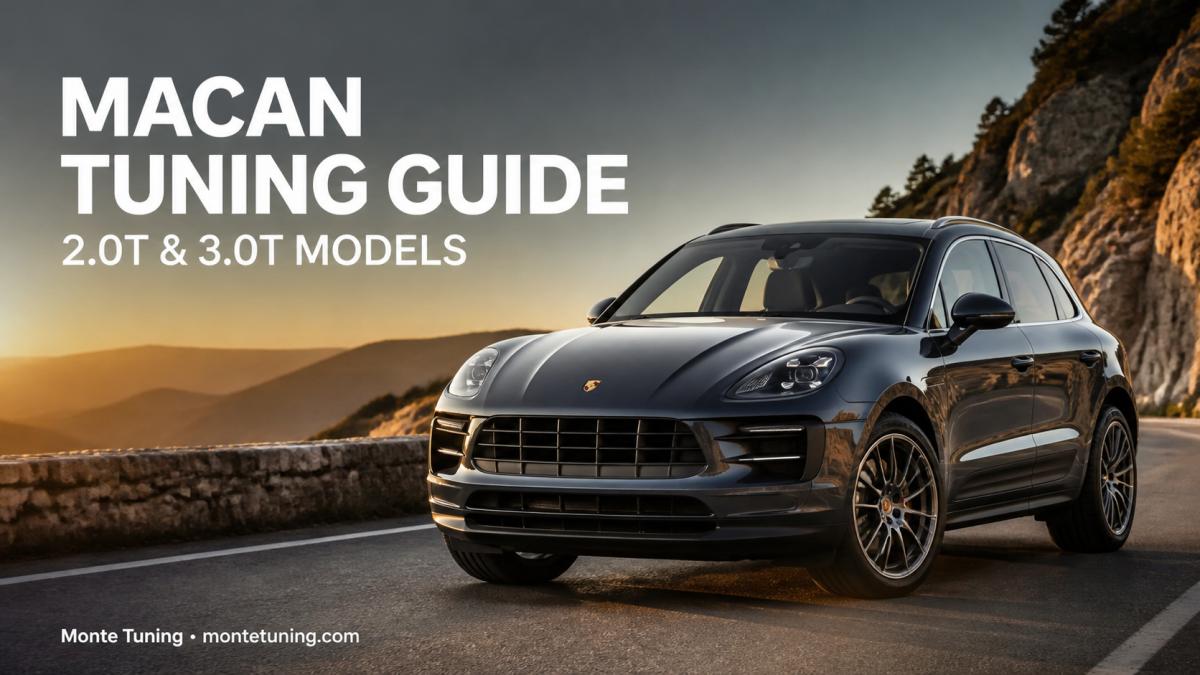
Porsche Macan tuning is the process of optimizing engine management parameters via the OBD2 port to safely unlock hidden horsepower, torque, and throttle response. By refining sensor data in real-time, this method enhances performance and fuel efficiency without the need for permanent ECU software modifications or specialized tools.
Driving a Porsche Macan, whether it is the agile 2.0T or the robust 3.0T V6, often feels like operating a vehicle with untapped potential. Porsche engineers naturally calibrate these engines to balance global emissions, varying fuel qualities, and distinct trim-level marketing. For many owners, this leaves a noticeable gap between the car’s actual mechanical capability and its daily on-road responsiveness.
The transition toward plug-and-play OBD2 solutions has shifted the landscape for enthusiasts who want more from their vehicle without the risks associated with permanent flashing. If you have ever felt your SUV hesitate during a highway merge or noticed a delay in power delivery, you are likely feeling the factory software holding back the engine’s true personality. Tuning is about reclaiming that headroom.
Understanding OBD2 Tuning Mechanics
Modern engines like the EA888 Gen 3/4 and the Porsche 3.0T V6 are sophisticated pieces of engineering. They rely on a complex network of sensors to monitor air-fuel mixtures, boost requests, and ignition timing. Traditional ECU flashing involves overwriting the factory code, which is a permanent change that can be detected by dealerships and erased by routine manufacturer updates.
In contrast, devices like the Monte GT and Monte GTR utilize the OBD2 port to communicate dynamically with the engine control unit. They intercept and refine signal data in real-time. Because these devices do not alter the base firmware, all OEM safety protocols—such as thermal management and knock detection—remain active. If the device is unplugged, the engine immediately reverts to its original factory configuration, leaving no digital footprint.
Performance Expectations and Data
While results are influenced by factors like fuel quality, environmental temperature, and individual engine health, dyno testing provides a reliable baseline for what to expect. Tuning the 2.0T EA888 engine typically yields gains between 35 and 70 horsepower, accompanied by a significant boost in torque. The 3.0T V6 platform often sees increases of 40 to 46 horsepower and substantial torque improvements ranging from 80 to 120 lb-ft.
Every vehicle and engine configuration responds differently to OBD2 tuning. Before purchasing, it’s worth checking compatibility with your specific make, model, year, and engine — and reviewing the setup guide for your device.
Practical Application and Installation
One of the primary benefits of this tuning approach is the simplicity of the process. No mechanical experience is required, and there is no need to visit a workshop. Once the device is plugged into the OBD2 port, the ECU requires a brief adaptation period, commonly referred to as a drive cycle. This typically involves 30 to 50 miles of varied driving to allow the engine to adjust its fuel trims to the new, optimized parameters.
It is important to remember that performance tuning is most effective when the vehicle is mechanically sound. High-boost operation is less forgiving of worn components. Owners should prioritize maintenance, particularly ensuring that spark plugs and ignition coils are in excellent condition. Additionally, using premium fuel is essential to achieve consistent, safe power gains; attempting to run a tuned engine on low-octane fuel will limit the device’s ability to optimize ignition timing.
| Feature | OBD2 Plug-and-Play | Permanent ECU Flash |
|---|---|---|
| Installation Method | DIY, OBD2 Port | Professional Bench/OBD Flash |
| Reversibility | Instant, zero trace | Requires restore to factory |
| Dealership Detection | No | Often yes (TD1 Code) |
| Effect of OTA Updates | None | Can overwrite/erase tune |

Browse all Monte Tuning OBD2 tuners →
Addressing Common Misconceptions
A frequent concern among Porsche owners is the fear of voiding a factory warranty or pushing the engine past its breaking point. It is helpful to view tuning as accessing the headroom that automotive engineers intentionally left on the table. The 2.0T engine, for instance, is used across the Volkswagen and Audi groups in various states of tune, often producing higher factory output than it does in the base Macan.
Another myth is that tuning is only for track-focused builds. Modern eco-tuning is a rapidly growing sector, where the focus shifts toward thermal efficiency and smoother power delivery. By increasing low-end torque, a tuned Macan can reach cruising speeds with less throttle input, which can contribute to better fuel economy during daily commutes.
Refining Your Macan Driving Experience
Choosing the right hardware depends on your specific goals. If you are looking to sharpen throttle response and improve daily drivability, understanding the capabilities of your Monte GT is a great first step. For those who want more aggressive performance gains and a more tailored tuning experience, the Monte GTR offers advanced optimization options. You can find detailed installation instructions in the Monte GT setup guide or the Monte GTR setup guide.
Expected gains, optimal drive cycle duration, and compatibility details vary by vehicle. The Monte Tuning support guides walk through setup step by step for each device model.
Check compatibility and explore the full lineup:
montetuning.com —
available for US, CA, UK, AU, and ES. Ships worldwide.
Frequently Asked Questions
Is OBD2 tuning safe for my Porsche Macan?
Yes, when using non-invasive OBD2 devices, your engine’s factory safety limiters remain fully operational. The device works within the engineered tolerances of your engine.
Will tuning my Macan void my warranty?
Unlike permanent ECU flashes that can be detected by diagnostic tools, plug-and-play OBD2 tuners do not trip flash counters or leave permanent modifications, allowing for a safer approach regarding warranty concerns.
Do I need a mechanic to install the tuner?
No. These devices are designed for plug-and-play installation via the OBD2 port, requiring no mechanical expertise or tools.
How long until I notice a difference in performance?
While you may feel an immediate change, the ECU typically requires a 30 to 50-mile drive cycle to fully adapt its fuel trims and timing for optimal performance.
How does this differ from a full ECU remap?
A remap overwrites the base code, which is permanent and often irreversible. An OBD2 tuner works in parallel with the ECU, allowing for real-time sensor refinement without altering the underlying factory software.