
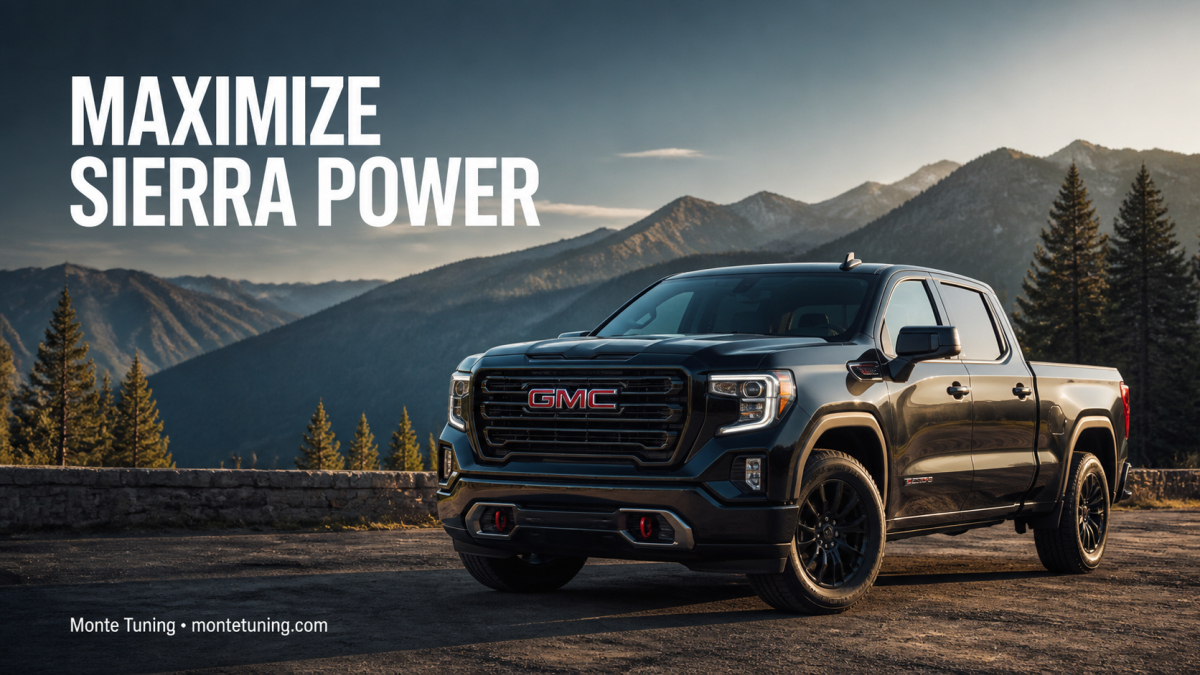
GMC Sierra 1500 tuning is the process of optimizing the factory Engine Control Unit (ECU) parameters via the OBD2 port to improve throttle response, torque delivery, and fuel efficiency. This approach allows drivers to refine engine performance without permanent code overwriting or complex mechanical modifications.
Driving a gmc sierra—whether it is a new 2026 model or a seasoned gmc sierra 1500—often reveals a common characteristic: the factory calibration is built for a global market, not necessarily for your specific driving style or local road conditions. Engineers must account for every possible variable, from low-quality fuel to extreme high-altitude operation, which often results in conservative throttle mapping and delayed gear shifts.
For owners of the gmc sierra denali or the off-road-focused gmc sierra 1500 at4x, these factory trade-offs can feel like lost potential. You do not need a degree in automotive engineering to reclaim that responsiveness, nor do you need to visit a shop for invasive modifications. Understanding how to manage your engine’s data flow is the first step toward a more refined driving experience.
1. Understand Your Engine Architecture
Modern trucks, particularly the gmc sierra 1500 2026, utilize complex electronic architectures. The 3.0L Duramax diesel and the 2.7L TurboMax represent the cutting edge of efficiency, while the 5.3L and 6.2L V8s remain staples of the gmc sierra lineup. Each engine reacts differently to tuning. Forced induction engines benefit significantly from optimized boost and fuel pressure, while naturally aspirated V8s often see the greatest improvements in throttle mapping and transmission shift points.
2. OBD2 Versus Flash Tuning
For years, “tuning” meant a permanent flash of the ECU. This often triggers a flash counter, which can be visible to dealership diagnostic tools during routine service. An OBD2 tuning module, such as the Monte GT or the Monte GTR, operates differently. It creates a secondary communication layer that optimizes sensor signals before they reach the ECU. Because it does not overwrite the base software, it is entirely reversible—you simply unplug the device to return the truck to its factory state.
3. The Calibration Drive Cycle
Many owners assume that performance gains are instantaneous the moment the ignition is turned. In reality, the gmc sierra 1500 ECU is a learning computer. After installing a tuning module, the vehicle needs a “calibration drive cycle.” During this period—typically 50 to 100 miles of mixed driving—the engine management system adapts its fuel trims and timing to the new, optimized sensor data. Be patient during these first few trips; the most noticeable changes often arrive after the computer has fully adjusted.

Browse all Monte Tuning OBD2 tuners →
4. Maintenance and Compatibility
No tuning device can fix a mechanical issue. If your gmc sierra 1500 is due for a new air filter or spark plugs, address those first. Tuning amplifies the engine’s existing performance, meaning it will highlight poor maintenance rather than mask it. Before purchasing, it’s worth checking compatibility with your specific make, model, year, and engine — and reviewing the setup guide for your device.
Every vehicle and engine configuration responds differently to OBD2 tuning. Before purchasing, it’s worth checking compatibility with your specific make, model, year, and engine — and reviewing the setup guide for your device.
5. Tuning Methods Comparison
| Method | Reversibility | Footprint | Ideal For |
|---|---|---|---|
| Plug-and-Play OBD2 | Fully Reversible | None | Daily driving, towing, MPG |
| Flash Mapping | Difficult/Permanent | Flash Counter Active | Heavily modified engines |
| Throttle Controllers | Reversible | None | Pedal feel only |
Performance Goals and Optimization
Drivers choose to optimize their gmc sierra for various reasons. For some, it is about eliminating the “dead pedal” hesitation when merging onto a highway. For others, it is about improving towing efficiency or squeezing a bit more range out of each tank of fuel. The goal of using a Monte GTR or a Monte GT is not to turn your truck into a race car, but to unlock the performance that is already present but constrained by factory settings.
When you decide to move forward, transparency matters. You can learn more about our approach at about Monte Tuning, where we detail how these modules safely work within OEM safety thresholds. Whether you are using a Monte GT setup guide or a Monte GTR setup guide, the process is designed to be accessible to anyone with a basic knowledge of their vehicle’s interior.
Check compatibility and explore the full lineup:
montetuning.com —
available for US, CA, UK, AU, and ES. Ships worldwide.
Frequently Asked Questions
Is OBD2 tuning safe for my GMC Sierra?
Yes. By working within the factory safety protocols—such as knock detection and thermal management—OBD2 modules ensure the engine operates within its designed mechanical limits.
Will this void my factory warranty?
Because plug-and-play devices do not overwrite the ECU code, they do not leave a “flash counter” footprint. They are fully reversible, meaning you can remove them before dealer service visits.
How long does it take to see results?
Most drivers notice a change in throttle response immediately, while fuel efficiency and advanced transmission shifting optimizations typically settle in after a 50 to 100-mile calibration drive cycle.
Do I need a mechanic to install the tuner?
No. These devices are designed for plug-and-play installation via the OBD2 port, which is located under the dashboard. No tools or mechanical experience are required.
How does this differ from a traditional ECU remap?
A remap physically changes the base software inside your ECU. An OBD2 tuner acts as an external processor that optimizes signals in real-time, which is safer for the electronics and avoids the risks associated with unauthorized software modifications.