
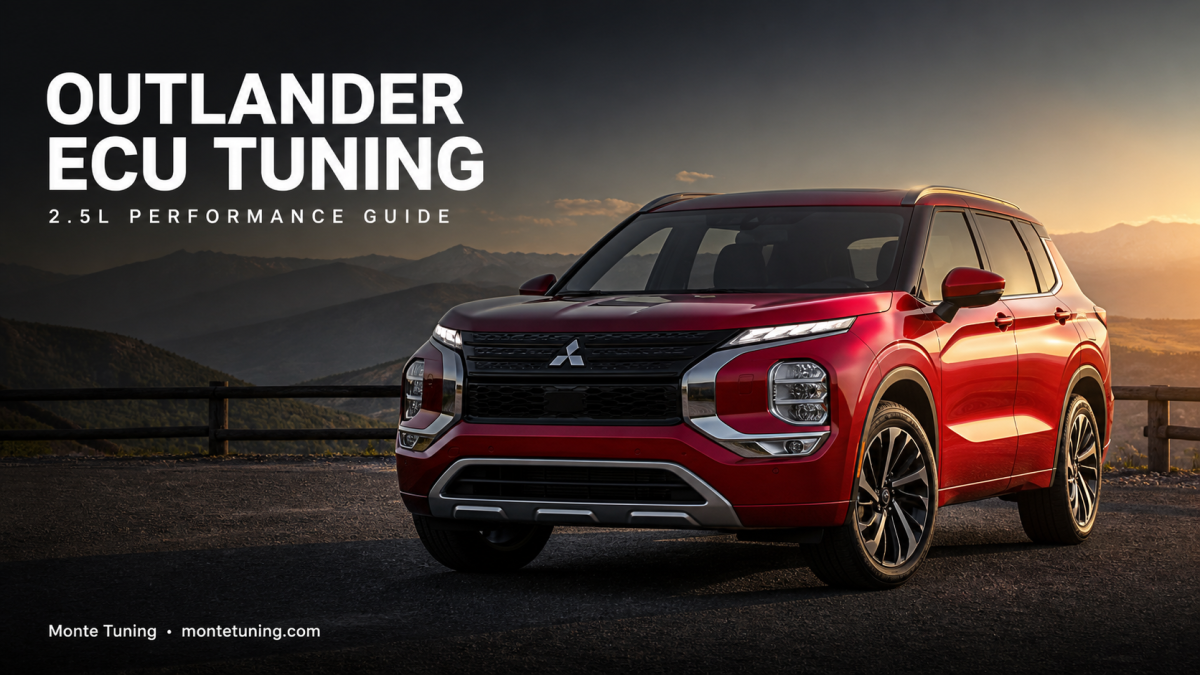
Mitsubishi Outlander ECU tuning is a process of optimizing the engine control unit’s communication with the vehicle’s sensors via the OBD2 port, which allows for improved throttle response, smoother power delivery, and increased efficiency in the 2.5L engine without permanent modifications.
Understanding the 2.5L Outlander Performance Profile
The Mitsubishi Outlander, particularly models from 2022 onwards, relies on the 2.5L naturally aspirated engine paired with a Continuously Variable Transmission (CVT). While this setup is reliable and efficient for daily commuting, many drivers experience a sense of sluggishness—often called throttle lag—when attempting to merge onto highways or navigate complex traffic. What I mean is, the factory calibration is intentionally conservative to account for varied fuel qualities and global environmental conditions.
Tuning this engine involves optimizing the ignition timing and fuel delivery maps. Unlike turbocharged vehicles that gain significant power through increased boost, the 2.5L Outlander benefits most from a refinement of the torque curve. By smoothing out the throttle tip-in, the vehicle feels more responsive, and the CVT’s behavior becomes more predictable during acceleration. This is achieved through real-time adjustment of sensor data, providing a more engaging driving experience.
Every vehicle and engine configuration responds differently to OBD2 tuning. Before purchasing, it’s worth checking compatibility with your specific make, model, year, and engine — and reviewing the setup guide for your device.
Engineering Standards and Safety
A common misconception is that all tuning devices work the same way. Many cheap, generic dongles found online are merely aesthetic, often doing nothing more than providing power to a small LED. A genuine OBD2 performance tuner interacts with the CAN bus, the digital nervous system of the vehicle, to make intelligent adjustments within the manufacturer’s safety tolerances. Because these devices do not perform a permanent flash of the ECU, the engine remains within its structural design limits.
Safety is the primary advantage of this non-invasive approach. Since there is no permanent code overwrite, the vehicle’s diagnostic history remains untouched, and any potential issues are avoided by reverting to stock settings. For owners concerned about warranty integrity, the ability to remove the device before a dealer visit is a significant practical benefit.

Browse all Monte Tuning OBD2 tuners →
Installation and Real-World Results
Modern tuning hardware is designed for simplicity. Installation typically takes minutes and requires no specialized tools or mechanic intervention. Once the device is connected to the OBD2 port, it enters a calibration phase where it learns the vehicle’s specific fuel trims and the driver’s habits. During this period, the engine’s performance characteristics gradually adjust to the optimized parameters.
What to Expect
- Improved throttle tip-in: Reduced lag during initial acceleration.
- Flattened torque curve: More consistent power delivery in the mid-range.
- Fuel efficiency optimization: Potential improvements depending on driving style and ECO-mode usage.
- Seamless integration: No permanent alterations to the ECU or factory software.
It is important to note that performance gains are not uniform. Factors such as altitude, fuel grade, and the current mechanical health of the engine—specifically the condition of air filters and spark plugs—will dictate the final outcome. Using higher octane fuel often allows the system to extract more performance, as the ECU is less likely to retard ignition timing to prevent knocking.
| Performance Factor | Factory Calibration | OBD2 Tuned State |
|---|---|---|
| Throttle Response | Standard/Delayed | Enhanced/Immediate |
| Torque Delivery | Linear/Conservative | Optimized/Responsive |
| ECU Modification | None (Permanent) | None (Removable) |
| Fuel Economy | Manufacturer Baseline | Variable (Driving Habits) |
Why Choose a Targeted Approach
Drivers choose to optimize their vehicles for various reasons, whether they are looking for better responsiveness for passing maneuvers or seeking more efficiency during long-distance road trips. A Monte GT or Monte GTR is designed for owners who appreciate precision engineering. By focusing on the nuances of the 2.5L engine, these devices allow for a driving experience that feels more tailored to individual preferences.
We believe in transparency regarding what tuning can and cannot do. We prioritize the longevity of your vehicle while providing an avenue to unlock performance that is often left on the table by factory defaults. If you are new to this process, the Monte GT setup guide and the Monte GTR setup guide provide clear, step-by-step instructions to get you started. To learn more about our philosophy, you can read about Monte Tuning and our commitment to automotive enthusiasts.
Check compatibility and explore the full lineup:
montetuning.com —
available for US, CA, UK, AU, and ES. Ships worldwide.
Frequently Asked Questions
Is OBD2 tuning safe for my Mitsubishi Outlander?
Yes, when using premium, properly engineered devices. Because they work within factory safety parameters and do not rewrite the ECU software, they are safe for daily driving.
Will tuning my vehicle void my warranty?
A dealer cannot void a warranty based on the presence of an aftermarket part unless they can prove that the part caused a specific failure. Because these tuners are removable and leave no digital footprint, they are considered a safe option.
Do I need a mechanic to install the tuner?
No. These devices are designed for plug-and-play installation. Simply locate your OBD2 port under the dashboard and follow the provided setup instructions.
How long until I notice a difference in performance?
Most owners notice an improvement shortly after the calibration drive cycle is completed, as the engine adapts to the new sensor signals.
Is this the same as a full ECU remap?
No. A remap involves permanently rewriting the ECU’s software. OBD2 tuning is a non-invasive, dynamic process that can be removed at any time to return the vehicle to factory stock.