
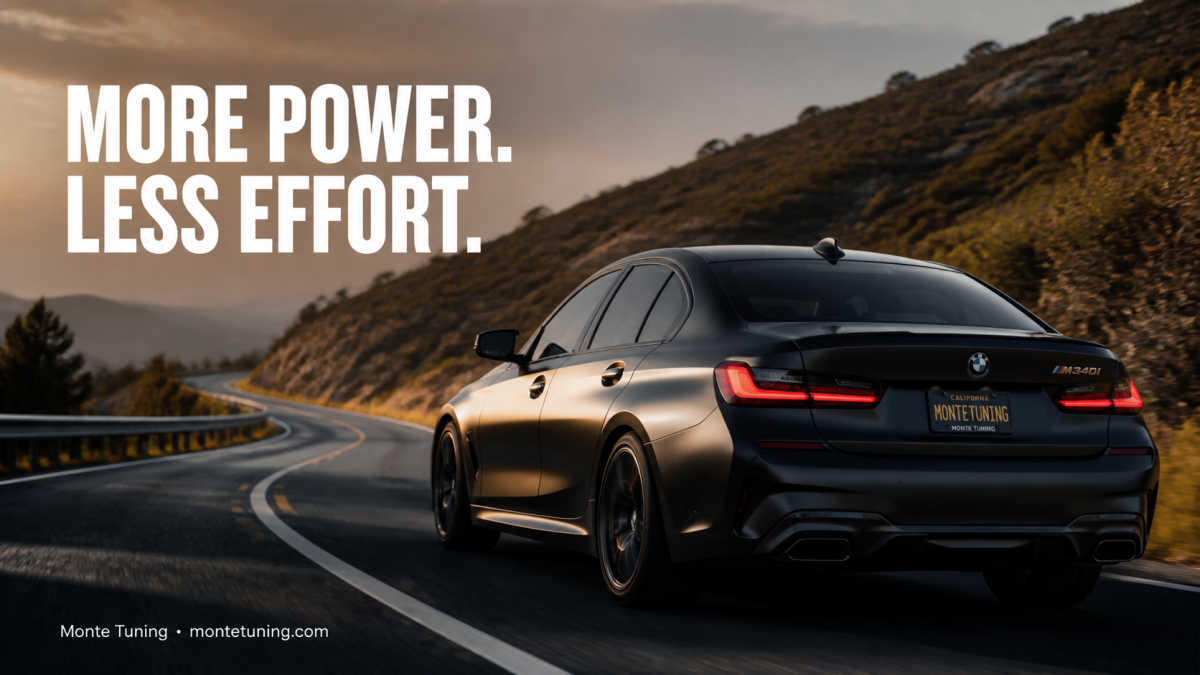
BMW ECU tuning is the process of optimizing the electronic control unit parameters, such as air-fuel ratios, ignition timing, and boost pressure, to enhance engine performance and fuel efficiency. OBD2 tuning solutions allow drivers to achieve these gains safely without permanent software modification or the need for a mechanic.
Most modern BMW owners know the feeling. The car is engineered with incredible precision, yet it often leaves power on the table to account for a vast spectrum of global fuel qualities and driving environments. Whether you are navigating traffic in London or tackling open roads in the US, the factory settings are essentially a compromise. The good news is that unlocking that hidden potential does not always require intrusive, permanent modifications that could put your warranty at risk.
When we look at the BMW engine lineup, from the nimble 2.0-liter units to the robust 3.0-liter straight-six engines, the goal remains the same: efficiency and responsiveness. For those looking to improve how their vehicle handles daily driving or highway cruising, understanding how to manage engine data via the OBD2 port is a game changer. It is about working smarter, not harder.
1. Optimizing Air-Fuel Ratios for Efficiency
Modern engines, particularly in the BMW 3 or BMW 1 series, operate on complex matrices that prioritize emission compliance over peak efficiency. By slightly adjusting the air-fuel mixture during light-load cruising, you can optimize combustion cycles. This is not about running the engine lean to the point of danger; it is about reaching the stoichiometric ideal that factory programming avoids to ensure compatibility with the lowest-grade fuels globally.
2. Refining Ignition Timing
Ignition timing determines exactly when the spark plug fires relative to the piston position. Factory tunes are conservative to prevent engine knock when using low-octane fuel. If you consistently use high-quality premium fuel, your engine is capable of more aggressive timing. OBD2 devices, like the Monte GT, help the ECU safely advance this timing to extract better thermal efficiency from every drop of fuel.
3. Enhancing Turbocharger Boost Mapping
For those interested in чип тюнинг дизелей бмв or high-output petrol engines like the B58, boost management is the primary driver of performance gains. Increasing turbo pressure within the OEM safety thresholds allows for more air mass, which, when paired with appropriate fueling, results in significant torque improvements. This is particularly noticeable in the BMW X5 or BMW X3 during passing maneuvers or highway acceleration.
Every vehicle and engine configuration responds differently to OBD2 tuning. Before purchasing, it’s worth checking compatibility with your specific make, model, year, and engine — and reviewing the setup guide for your device.

Browse all Monte Tuning OBD2 tuners →
4. Sharpening Throttle Response
One of the most common complaints among BMW enthusiasts is the electronic throttle delay, often called dead pedal feel. This is a manufacturer-programmed buffer designed to smooth out jerky driver inputs. By intercepting the pedal signal and optimizing the delivery, you can make the car feel more connected and immediate without changing the underlying engine character.
5. Managing Modern ECU Locks
Since 2020, BMW has implemented strict security on Bosch MD1 and MG1 ECUs, making traditional flash tuning difficult and risky. Attempting to force a flash tune can lead to bricking the ECU or voiding warranties. This is where plug-and-play modules like the Monte GTR excel. Because they operate externally on the CAN bus, they bypass these locks entirely and remain invisible to dealership software updates.
Performance Comparison by Tuning Method
| Method | Install Difficulty | Warranty Risk | Reversibility |
|---|---|---|---|
| OBD2 Plug-and-Play | Low (Minutes) | Minimal | Instant |
| ECU Flash / Remap | High (Professional) | High | Difficult/Permanent |
| Bench Unlock | Extreme (Hardware) | Very High | None |
Expected gains, optimal drive cycle duration, and compatibility details vary by vehicle. The Monte GTR setup guide and Monte GT setup guide walk through setup step by step for each device model.
The Evolution of DIY BMW Performance
The shift toward modular tuning is not just about convenience; it is a response to how vehicle technology has evolved. Drivers now expect their vehicle to be as adaptable as their smartphone. Whether you are looking for a subtle boost in MPG for your daily commute or a more responsive drive in your BMW G30, the ability to install and remove a device yourself is invaluable.
Understanding the about Monte Tuning philosophy helps clarify why this approach is gaining traction. It is about providing enthusiasts with the tools to personalize their driving experience while respecting the mechanical limits of the vehicle. By keeping the factory bootloader intact, you ensure your car remains compliant with modern diagnostic requirements.
Check compatibility and explore the full lineup:
montetuning.com —
available for US, CA, UK, AU, and ES. Ships worldwide.
Frequently Asked Questions
Is OBD2 tuning safe for my engine?
Yes, provided the device respects the OEM ECU’s safety thresholds. Devices like the Monte GT and GTR operate within factory limits, allowing the ECU’s built-in knock sensors and temperature protections to remain fully active.
Will tuning my BMW void my warranty?
Plug-and-play OBD2 tuners do not permanently alter the ECU memory or increment flash counters. By removing the device before a dealer visit, the vehicle returns to its original factory state, leaving no digital footprint.
How long does it take to see results?
Most vehicles require an adaptation phase, typically between 50 to 150 miles. During this time, the engine learns to optimize its parameters based on the new sensor data provided by the tuner.
Do I need a mechanic to install the device?
No. These devices are designed for plug-and-play installation via the OBD2 port, typically located under the driver-side dashboard. No specialized tools or mechanical experience are required.
How does this differ from a full ECU remap?
A full remap overwrites the base software in the ECU, which is often permanent and detectable. An OBD2 tuner works in parallel, intercepting data in real time, making it reversible and safer for vehicles under warranty.