Do Performance Chips Really Work?
On this page
Short answer: some do, many don’t. The word “chip” covers two very different kinds of product. One kind changes how the engine computer runs the engine — and shows it on a dyno. The other is a cheap impulse buy that promises outrageous power gains and changes nothing. That second kind is where the bad reputation comes from.
Below: what a performance chip is, why so many don’t work, what the ones that do actually add — with our own measured results and where each one comes from — and how to tell them apart before you buy.
What Is a Performance Chip?
“Performance chip” is a name used for anything small you plug into a car to make it faster. In practice there are two families:
- Sensor boxes and OBD “chips”. A resistor wired into a sensor line, or a plug with a blinking LED. They don’t change the engine calibration.
- ECU tuners. Devices that change the calibration the engine computer (ECU) runs on, made for the exact engine.
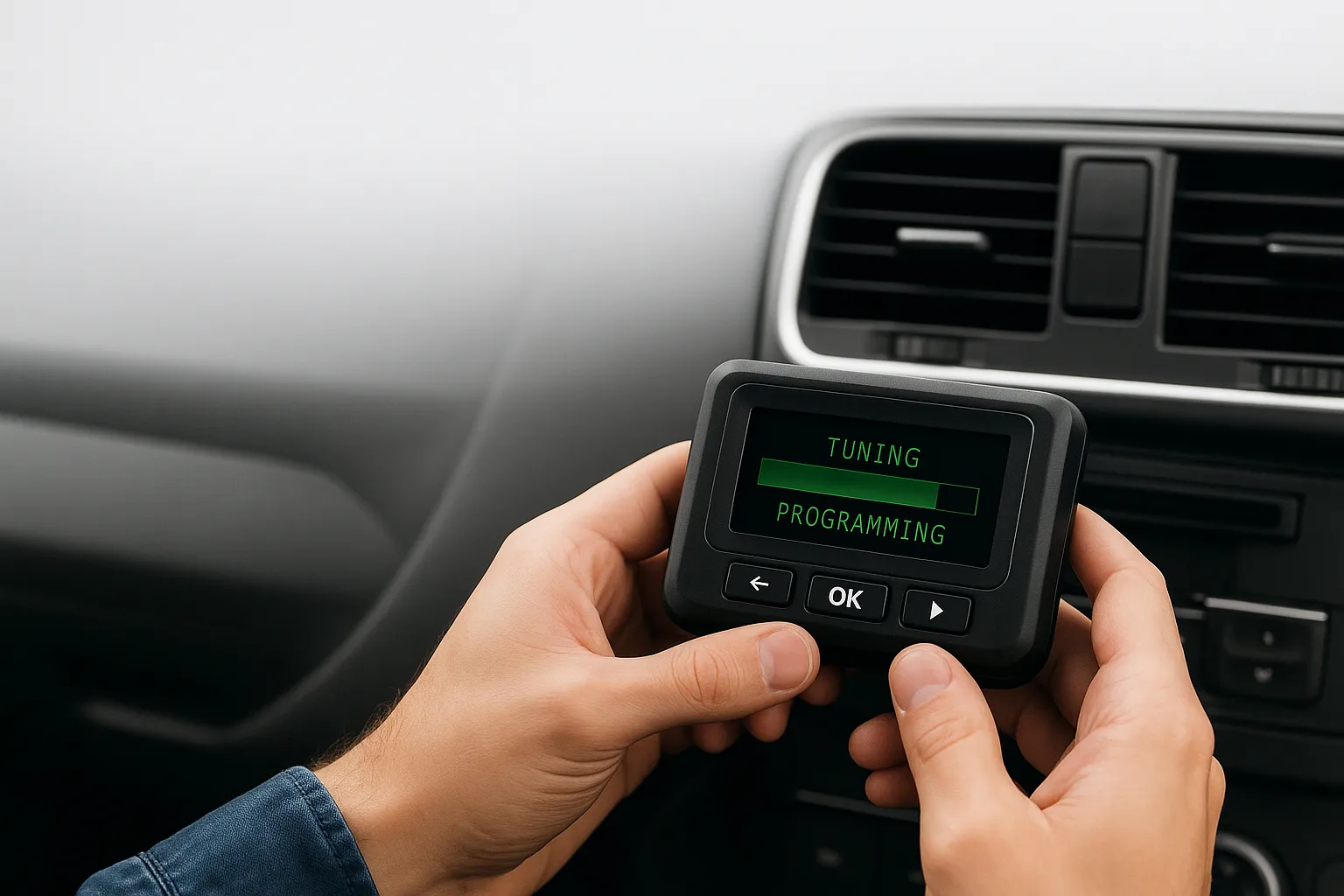
Only the second family can add real power. Monte belongs to it: a plug-in ECU tuner that carries a calibration for your exact engine and plugs into the OBD-II port.
Do Performance Chips Actually Work?
They work when they change the calibration. An engine makes more power when its calibration is changed for that exact engine. A device that does that shows it on a chassis dyno, before and after.
A device that doesn’t touch the calibration can’t add power, whatever the box says. That is the whole difference, and it is testable.
Why Some People Think Performance Chips Don’t Work
Because many of the “chips” sold online really don’t. The typical one is cheap, promises 30–35% more power on any car, and inside is a resistor or an LED.
- A resistor box makes the engine computer think the intake air is colder than it is. Modern ECUs correct for that within minutes, or set a fault code.
- An OBD plug with a light writes nothing to the car. Nothing is changed, so nothing happens.
So when people say “performance chips are a scam”, they are usually right — about those chips.
Is There a Performance Chip That Actually Works?
Yes — anything that changes the engine calibration. There are three ways to do it:
- Flash tune. The ECU’s stored software is rewritten with a new map. The largest gains; also the most invasive, and a dealer scan can often see it.
- Piggyback. A box wired between the sensors and the ECU that alters signals on the fly. Moderate gains, mostly on turbo engines.
- Plug-in ECU tuner (Monte). A device in the OBD-II port with a calibration made for your exact engine and year, without rewriting the ECU’s stored software. Unplug it and the car is stock.
The test for all three is the same: a dyno result before and after, with the source named.
How Much Horsepower Does a Performance Chip Add?
Here is what Monte measured, on a chassis dyno, before and after:
| Car | Engine | Gain | Source |
|---|---|---|---|
| Ford F-150 Raptor | 3.5 EcoBoost | +21 hp, +31 lb-ft | Lab test, SEMA Garage, Diamond Bar, CA |
| Mercedes C300 | 2.0 turbo | +25.1 hp, +72.2 lb-ft | Dyno on video |
| Nissan 370Z | 3.7 V6 | +22.3 hp, +16.8 lb-ft | Dynocom customer dyno report |
| Abarth 595 | 1.4 T-Jet | +20.6 hp, +13.7 lb-ft | Dyno on video |
| Mazda MX-5 | 2.0 | +16.6 hp, +17.1 lb-ft | Dynocom customer dyno report |
The gains are real and they are moderate — 15 to 25 horsepower on these cars, not 80. Up to 20% on a turbocharged engine and up to 12% on a naturally aspirated one. Turbo engines usually gain the most.
Do Performance Chips Work in Trucks?
Yes, and turbo trucks are where a calibration has the most room. The F-150 Raptor above gained 21 hp and 31 lb-ft in an independent lab test at SEMA Garage. Monte covers the F-150, Ram 1500, Silverado and Super Duty, and the Duramax, Power Stroke, Cummins and EcoDiesel engines — see the truck tuner page and the catalogue for each engine.
What Is the Downside of Chip Tuning?
- Cheap chips: the money. They don’t do anything.
- Any real tune: more load on the engine when you use the extra power. Use performance modes as intended.
- Flash tunes: the change is permanent until you flash back, some ECUs must be unlocked first, and a dealer can often see that the calibration was changed.
- Plug-in tuners: gains are smaller than a custom flash. That is the trade for being able to unplug and go back to stock.
Are Performance Chips Safe?
A resistor box isn’t dangerous so much as pointless. A real tune is as safe as its calibration. Monte adjusts the calibration inside the ranges the factory ECU already allows and leaves every factory safeguard and knock-protection strategy active. Independent bench testing at SEMA Garage found no fault codes and no disabled systems.
Do Performance Chips Affect Fuel Economy?
A calibration can change consumption in either direction. Power modes use more fuel when you use the power. Monte’s Economy modes are made for steady, relaxed driving; how much fuel they save depends on the car and how it’s driven, and we don’t quote a figure until we’ve measured it. A chip that promises big fuel savings on any car is the same kind of box as the one that promises big power.
How to Tell a Real Performance Chip from a Fake
- Dyno before and after, with the source named. No dyno — no claim.
- Written for your engine. One box for every car is a red flag.
- Believable numbers. Up to about 20% on a turbo engine is plausible; “35% on any car” is not.
- A way back to stock — and you should know what stays recorded.
Monte GT vs Monte GTR
Both carry the same calibration for your engine. Monte GT is set up and switched from the Monte app on your phone. Monte GTR adds its own touch screen with live gauges, a code reader, a 0–60 timer and a virtual dyno. Compare them in the shop.
Final Verdict: Do Performance Chips Really Work?
The ones that only fool a sensor don’t. The ones that carry a calibration for your specific engine do — by a moderate, measurable amount. Ask for the dyno result, check it’s written for your engine, and keep a way back to stock.
Want Proven Results?
Check what Monte does on your car: pick your make and model to see the factory ratings, our estimate and the measured results. Check my car →

