
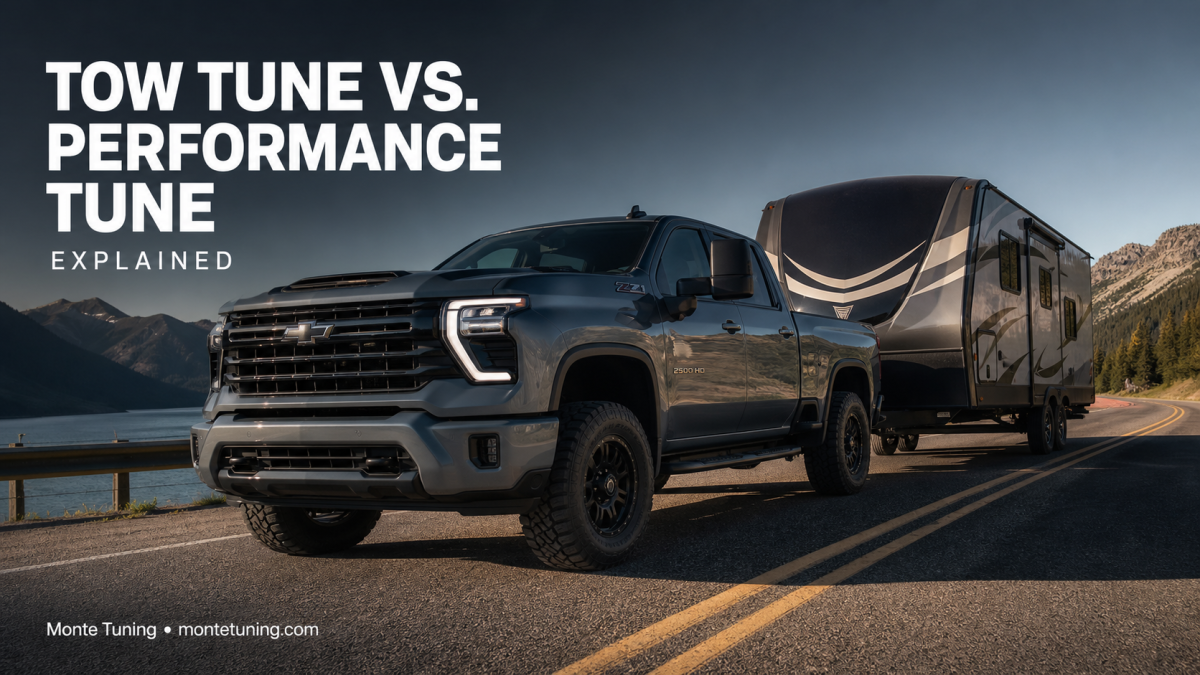
ECU tuning differentiates between tow and performance calibrations by adjusting engine parameters like air-fuel ratios, ignition timing, and boost pressure to meet specific load requirements. Tow tunes prioritize sustained cooling and low-end torque, while performance tunes focus on throttle sensitivity and maximum power for short bursts.
If you have ever felt your truck struggle to maintain speed on a long highway climb, or noticed a frustrating delay when you press the accelerator, you have likely encountered the limitations of factory engine software. Manufacturers calibrate engines for a middle-ground—a compromise designed to satisfy a wide range of drivers, emissions requirements, and fuel qualities across different markets. For the enthusiast or the driver who puts their vehicle to work, these factory defaults often leave significant potential on the table.
Understanding the distinction between towing and performance profiles is the first step toward getting more from your vehicle. It is not just about raw horsepower; it is about how your engine delivers power when you actually need it. Whether you are hauling a heavy trailer or looking for a more responsive daily commute, the approach to how you modify those engine signals matters.
The Engineering Behind the Calibration
At an engineering level, internal combustion engines rely on a delicate balance of air-fuel ratio, ignition timing, and boost pressure. When you plug in a device like the Monte GT, you are not permanently changing the factory code; you are refining the signals the engine control unit receives from its sensors.
The Towing Logic
A tow-oriented calibration is built for endurance. When pulling a heavy trailer, exhaust gas temperatures can climb rapidly, putting stress on the turbocharger and the cooling system. A proper tow tune focuses on low-to-mid-range torque, allowing the engine to generate power at lower RPMs. By optimizing the torque request, the system prevents the transmission from constantly shifting or hunting for gears on inclines, which keeps the engine in its most efficient power band without inducing thermal fatigue.
The Performance Logic
Performance tuning is designed for agility. It focuses on sharpening throttle tip-in, which removes the pedal lag commonly found in modern drive-by-wire systems. By advancing ignition timing and slightly raising boost limits, a performance map provides a more immediate surge of power. This is ideal for passing or highway merging, though it is meant for short durations rather than the sustained, heavy-load output required for towing thousands of pounds of cargo.
Installation and Real-World Compatibility
Every vehicle and engine configuration responds differently to OBD2 tuning. Before purchasing, it’s worth checking compatibility with your specific make, model, year, and engine — and reviewing the setup guide for your device.
Installation is generally straightforward, but it requires a baseline of healthy hardware. A tune will amplify the strengths of your engine, but it will also highlight existing weaknesses. Ensure your vehicle has clean oil, fresh spark plugs, and no vacuum leaks before installation. Once plugged into the OBD2 port, the system begins communicating over the CAN bus network. Most modern vehicles require a short drive cycle—typically 50 to 100 miles—for the engine control unit to adapt to the new, optimized sensor signals.
Browse all Monte Tuning OBD2 tuners →
Comparison of Tuning Approaches
| Feature | Factory Default | Tow Optimized | Performance Optimized |
|---|---|---|---|
| Throttle Response | Standard / Laggy | Balanced / Linear | Sharpened / Direct |
| Mid-Range Torque | Baseline | Increased | Enhanced |
| Primary Focus | Emissions/General | Thermal Efficiency | Power Delivery |
| Best Usage | Daily Commute | Hauling / RVing | Sport Driving |
Managing Expectations and Vehicle Health
It is important to address the most common mistake: using a performance map for heavy-duty towing. Performance maps are not designed to manage the high exhaust gas temperatures associated with sustained heavy loads, which can lead to transmission stress. Conversely, a tow tune will not provide the aggressive acceleration feel of a dedicated performance setting. The key is using the right tool for your specific journey.
Expected gains, optimal drive cycle duration, and compatibility details vary by vehicle. The Monte GTR setup guide and the Monte GT setup guide walk through setup step by step for each device model to ensure you are getting the most out of your vehicle’s specific parameters.
Why Drivers Choose Plug-and-Play Solutions
For those who want to avoid the “warranty anxiety” associated with permanent ECU flashes, OBD2 modules offer a clean, reversible alternative. Because they do not overwrite the vehicle’s base software, they do not leave a “flash counter” or digital footprint that would typically be detected during a routine dealer service. This is particularly relevant in the era of encrypted ECUs and over-the-air updates, where traditional tunes are frequently wiped by manufacturer software pushes.
Whether you are considering the Monte GT for a daily driver or the more advanced Monte GTR for a performance-oriented SUV, these devices provide a way to enhance your vehicle’s capability without the complexity of a mechanic or a garage remap. You can learn more about the philosophy behind our approach by visiting the about Monte Tuning page.
Check compatibility and explore the full lineup:
montetuning.com —
available for US, CA, UK, AU, and ES. Ships worldwide.
Frequently Asked Questions
Is OBD2 tuning safe for my engine?
Yes, when using reputable plug-and-play devices that operate within the manufacturer’s established safety margins for sensors and air-fuel ratios.
Will this void my factory warranty?
Plug-and-play devices like those from Monte Tuning are reversible. Because they do not overwrite the ECU code, they do not trigger the flash counters that dealers typically look for during warranty service.
How long until I notice a difference?
Most drivers feel an immediate improvement in throttle response. Full optimization of fuel trims typically occurs after a 50 to 100-mile drive cycle as the ECU adjusts to the new signals.
Do I need a mechanic to install the device?
No. These devices are designed for plug-and-play installation via the OBD2 port, allowing you to install or remove the unit in minutes without specialized tools.
How does this differ from a full ECU remap?
A remap permanently overwrites the car’s software. An OBD2 module dynamically modifies sensor signals in real-time to optimize performance, making it easier to revert to stock conditions.