
Car tuning is the process of optimizing a vehicle’s engine control unit (ECU) parameters to improve horsepower, torque, and fuel efficiency. By refining ignition timing and air-fuel ratios through OBD2 diagnostic ports, drivers can unlock hidden engine potential without permanent modifications or the need for professional mechanic intervention.
Understanding Modern Vehicle Performance
Most factory-tuned engines are designed with conservative safety buffers to accommodate extreme climates, low-grade fuel, and varying maintenance standards. This leaves a significant amount of untapped performance potential in the ECU’s software. Many drivers assume that unlocking this power requires a complex visit to a shop or permanent remapping, but the reality is often much simpler and less intrusive.
For the everyday driver, the goal is often not just raw top-end speed, but improved drivability. This means eliminating the common “dead zones” in the throttle pedal, smoothing out acceleration, and potentially squeezing more miles per gallon during long highway commutes. Achieving this balance is the primary function of modern OBD2 tuning solutions.
The Evolution of Tuning Methods
The landscape of vehicle performance has shifted from invasive, hardware-heavy modifications toward software-based optimization. Professional bench remapping remains a standard for heavy track builds, but the rise of smart, plug-and-play modules has made performance tuning accessible to the average car owner.
Every vehicle and engine configuration responds differently to OBD2 tuning. Before purchasing, it’s worth checking compatibility with your specific make, model, year, and engine — and reviewing the setup guide for your device.
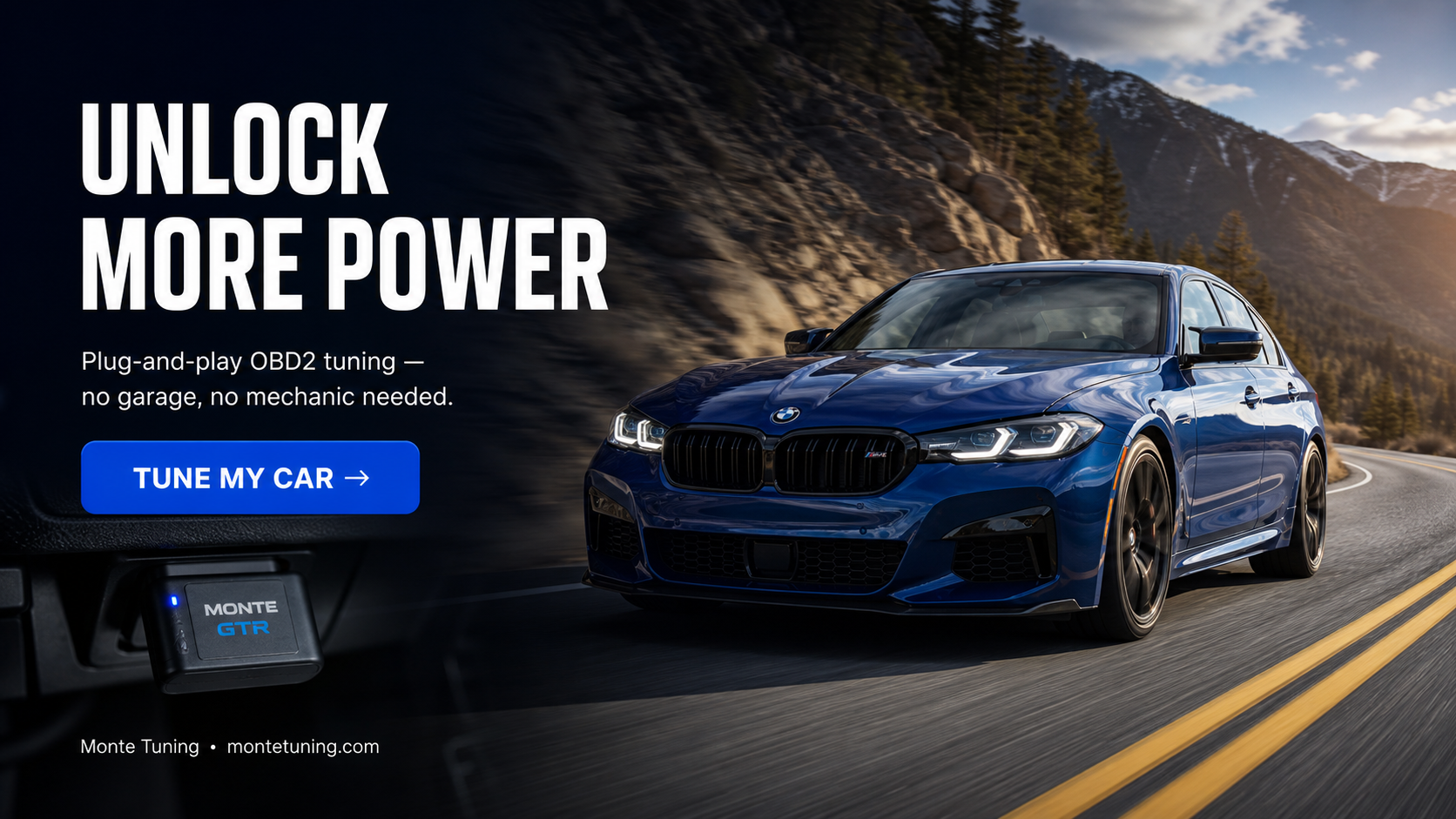
Browse all Monte Tuning OBD2 tuners →
Performance Gains and Expectations
Results depend largely on the engine type. Turbocharged and supercharged engines typically see the most immediate impact, as tuning devices can optimize boost levels alongside fueling parameters. Naturally aspirated engines, while more limited in how much they can be pushed, still benefit from refined ignition timing that makes the engine feel more responsive.
| Engine Type | Performance Potential | Fuel Economy Focus |
|---|---|---|
| Turbocharged / Supercharged | High (25–60+ HP gains) | Significant efficiency gains |
| Naturally Aspirated (NA) | Moderate (5–15% gains) | Improved throttle response |
| Turbodiesel | High (20–50 HP gains) | Increased torque delivery |
Installation and the Drive Cycle
One of the most common misconceptions is that a tuner provides immediate, peak performance the second it is plugged in. Modern vehicle ECUs are adaptive; they require a “drive cycle” to recognize the optimized signals from a device like the Monte GT or Monte GTR. This usually involves 50 to 150 miles of mixed city and highway driving.
During this period, the ECU maps the new data inputs to your specific driving habits. Pushing the engine to redline immediately after installation is counterproductive. Instead, driving normally allows the system to calibrate safely, resulting in a much smoother, more predictable power delivery once the adaptation is complete.
Technical Realities and Safety
Regulatory changes in 2026 and ongoing advancements in ECU encryption have made traditional “flashing” more difficult. Manufacturers now use Over-The-Air (OTA) updates that can wipe out custom software tunes. Because an OBD2 device works externally as an interceptor, it remains unaffected by factory software updates.
Regarding safety, quality OBD2 modules operate strictly within the manufacturer’s engineered safety limits. They do not bypass critical engine protections. Regarding the Magnuson-Moss Warranty Act in the US, an aftermarket part does not automatically void a warranty; the manufacturer must prove the part caused a specific failure. Because these devices are reversible and leave no trace on the ECU’s flash counter, they provide a much safer alternative for owners concerned about their vehicle’s warranty status.
Performance for Your Daily Drive
Whether you are looking to refine a daily commuter or extract more responsiveness from a performance-oriented vehicle, the choice of equipment matters. Those interested in the engineering philosophy behind these devices can learn more about Monte Tuning to understand our approach to safe, reversible power. For those ready to start, the Monte GT setup guide and Monte GTR setup guide provide the necessary steps to ensure a smooth transition from stock settings to an optimized driving experience.
Check compatibility and explore the full lineup: montetuning.com — available for US, CA, UK, AU, and ES. Ships worldwide.
Frequently Asked Questions
Is OBD2 tuning safe for my engine?
Yes, when using reputable devices that operate within the engine’s factory-set safety margins, tuning is a safe way to optimize performance.
Will a tuning device void my vehicle warranty?
In the US, the Magnuson-Moss Warranty Act protects consumers. A dealership must prove an aftermarket part caused a specific failure to deny a warranty claim, and because these devices are reversible and leave no flash trace, they are highly warranty-friendly.
Do I need a mechanic to install the device?
No. These devices are designed for plug-and-play installation into the OBD2 port, typically located under the dashboard. No mechanical knowledge or specialized tools are required.
How long does it take to see results?
While throttle response is often improved instantly, full engine optimization occurs after a drive cycle of approximately 50 to 150 miles.
Is the process reversible?
Yes. The primary advantage of an OBD2 plug-and-play tuner is that you can unplug it at any time to return the vehicle to its original factory settings.