
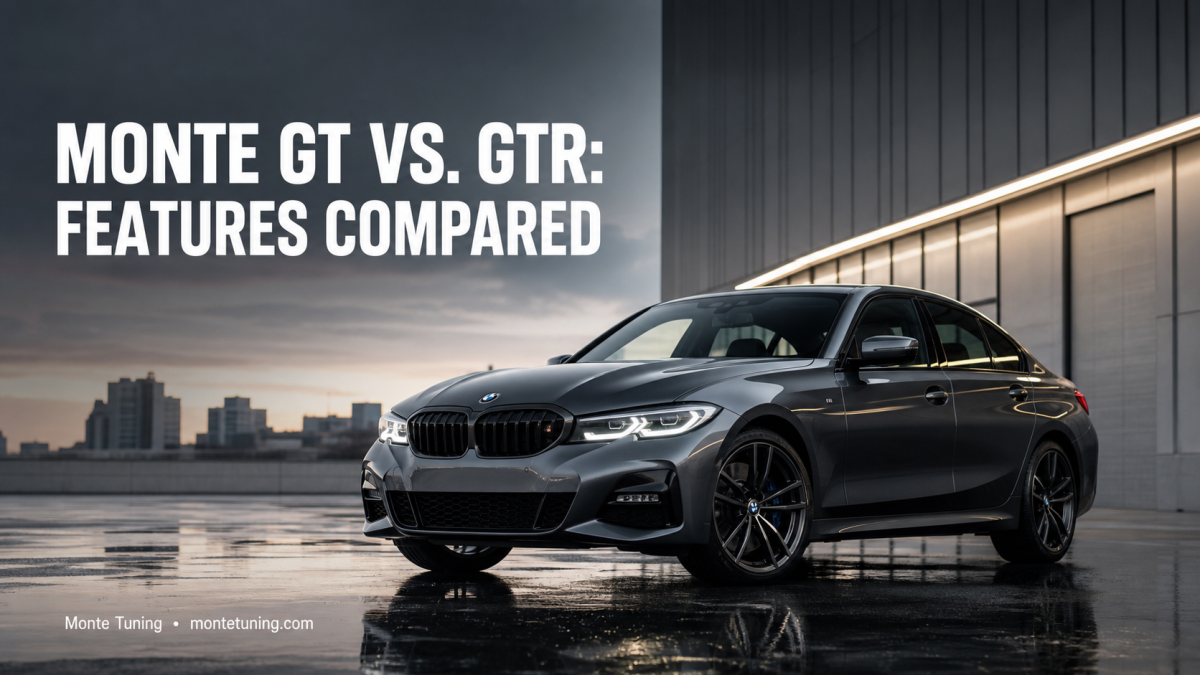
The Monte GT and Monte GTR are plug-and-play OBD2 performance devices designed to optimize engine parameters like fuel delivery, ignition timing, and boost pressure in real-time. By utilizing the vehicle’s existing CAN-bus architecture, these units provide improved throttle response and efficiency without the risks associated with permanent ECU remapping.
Modern vehicle ownership often feels like a compromise between factory-set efficiency and the desire for a more responsive driving experience. Many enthusiasts find themselves navigating a sea of invasive mechanical modifications or high-cost permanent flashes, neither of which feels quite right for a daily driver. The core challenge is simple: how to unlock the hidden potential of an engine while maintaining the safety margins dictated by the manufacturer.
The distinction between the Monte GT and Monte GTR often comes down to how much data and control the driver wants at their fingertips. While both units utilize the same core technology to interface with the vehicle’s diagnostic port, they serve different styles of engagement. Whether you are optimizing a diesel truck in Australia or a turbocharged hatch in the UK, the goal remains the same: a smoother, more efficient, and more capable engine.
Engineering the Modern OBD2 Experience
To understand why these devices are effective, one must look at how modern Engine Control Units function. Manufacturers often calibrate vehicles to accommodate a wide range of global fuel qualities and varying climates, which leaves significant room for optimization. Unlike a permanent flash that overwrites the engine’s original software, OBD2 tuning operates as a dynamic, intelligent interface.
These devices communicate directly with the ECU via the CAN-bus. By requesting optimized signals for fuel trims and timing, the system effectively recalibrates the engine’s behavior within safe OEM limits. Because the factory ECU remains in control, critical safety features like knock detection and limp-mode protocols stay fully active. This approach ensures the engine operates within its designed capacity, just more efficiently.
Every vehicle and engine configuration responds differently to OBD2 tuning. Before purchasing, it’s worth checking compatibility with your specific make, model, year, and engine — and reviewing the setup guide for your device.
Feature Comparison: Performance vs. Data
Choosing between a Monte GT and a Monte GTR often depends on whether you view your car as a daily tool or a performance project. The GT model is built for the driver who wants a set-it-and-forget-it performance upgrade. It is optimized for those seeking improved pedal feel and better fuel economy through a straightforward smartphone app interface.
The GTR model, conversely, acts as an on-board performance cockpit. It includes a physical touchscreen, which allows for real-time diagnostics, fault code scanning, and even virtual dyno estimations. It is essentially an analytics suite for the car enthusiast who wants to track their performance gains—such as 0-60 acceleration times—in real-time.
| Feature | Monte GT | Monte GTR |
|---|---|---|
| Interface | Smartphone App | Integrated Touchscreen |
| Performance Maps | Power / Economy / Efficiency | Power / Economy / Efficiency |
| OBD2 Diagnostics | Basic | Advanced (Read/Clear Codes) |
| Data Tracking | Limited | Virtual Dyno & 0-60 Timer |
| Installation | Plug-and-Play | Plug-and-Play |

Browse all Monte Tuning OBD2 tuners →
Installation and Real-World Expectations
Installation is designed to be accessible, requiring no tools or professional mechanical help. The device plugs into the OBD2 diagnostic port, typically located under the steering column. Once connected, the system requires a brief “learning phase.” Modern ECUs are adaptive; they need a drive cycle of roughly 50 to 100 miles to adjust fuel trims and sensor parameters to the new signals provided by the tuner.
Drivers should keep a few practical points in mind to ensure the best results:
- Maintenance Matters: An engine with old spark plugs or a dirty air filter will not perform well, regardless of the tune.
- Fuel Quality: Running a performance-focused map requires appropriate, higher-octane fuel to prevent the factory ECU from pulling timing.
- Patience: Do not judge the improvement in the first few miles. The ECU requires time to adapt its internal mapping.
While the market is flooded with various aftermarket parts, understanding that OBD2 tuning is about optimization rather than magic is key. If a vehicle has existing mechanical faults, such as a boost leak or an aging sensor, the tuner will highlight these issues rather than mask them.
Why Choose OBD2 Over Flash Tuning
In an era of encrypted ECUs and frequent Over-The-Air (OTA) software updates, flash tuning has become increasingly risky. A dealer visit can easily result in your expensive custom tune being wiped by a factory software patch. Furthermore, flash tuning often leaves a digital footprint in the ECU’s memory, which can complicate warranty claims.
An OBD2 solution from about Monte Tuning offers a distinct advantage: reversibility. Because these devices communicate externally, they do not leave a flash counter trace. When it is time for a dealer service, the device can simply be unplugged, returning the vehicle entirely to its factory state. This provides peace of mind for owners of newer vehicles or those conscious of the Magnuson-Moss Warranty Act standards.
Maximizing Your Driving Experience
The journey toward better performance is a personal one. Some drivers seek the Monte GT to regain some fuel economy lost to heavy city traffic or to make their daily commute more responsive. Others prefer the data-centric approach of the Monte GTR to see exactly how their engine responds under load. Both routes avoid the pitfalls of invasive hardware modifications and the permanence of ECU flashes.
As you explore your options, remember that the goal is a balanced, enjoyable car that performs better across the rev range. By leveraging intelligent OBD2 communication, you are not just adding power; you are refining the way your vehicle operates. Refer to the Monte GT setup guide or the Monte GTR setup guide to understand the specific installation steps for your vehicle before you begin.
Check compatibility and explore the full lineup:
montetuning.com —
available for US, CA, UK, AU, and ES. Ships worldwide.
Frequently Asked Questions
Is OBD2 tuning safe for my engine?
Yes, because the device works within the factory’s pre-defined safety limits. The factory ECU remains the primary authority and continues to manage all critical safety parameters, such as knock detection.
Will this void my vehicle warranty?
Unlike a permanent ECU flash, our devices do not overwrite the base software or trigger flash counters. Since the device can be removed entirely before a service visit, it is a non-permanent modification.
Do I need a mechanic for installation?
No, the process is designed for DIY enthusiasts. The device simply plugs into the OBD2 port under the dash, requiring no mechanical experience.
How long does it take to see results?
While throttle response changes are often immediate, the full benefit regarding fuel economy and engine power is realized after a 50-100 mile adaptive drive cycle as the ECU adjusts to the new data.
What is the difference between this and a full ECU remap?
A remap is a permanent software change that overwrites the ECU’s base code, which is difficult to reverse and often detectable by dealers. OBD2 tuning is a plug-and-play solution that communicates externally, making it safer, reversible, and immune to factory software updates.