
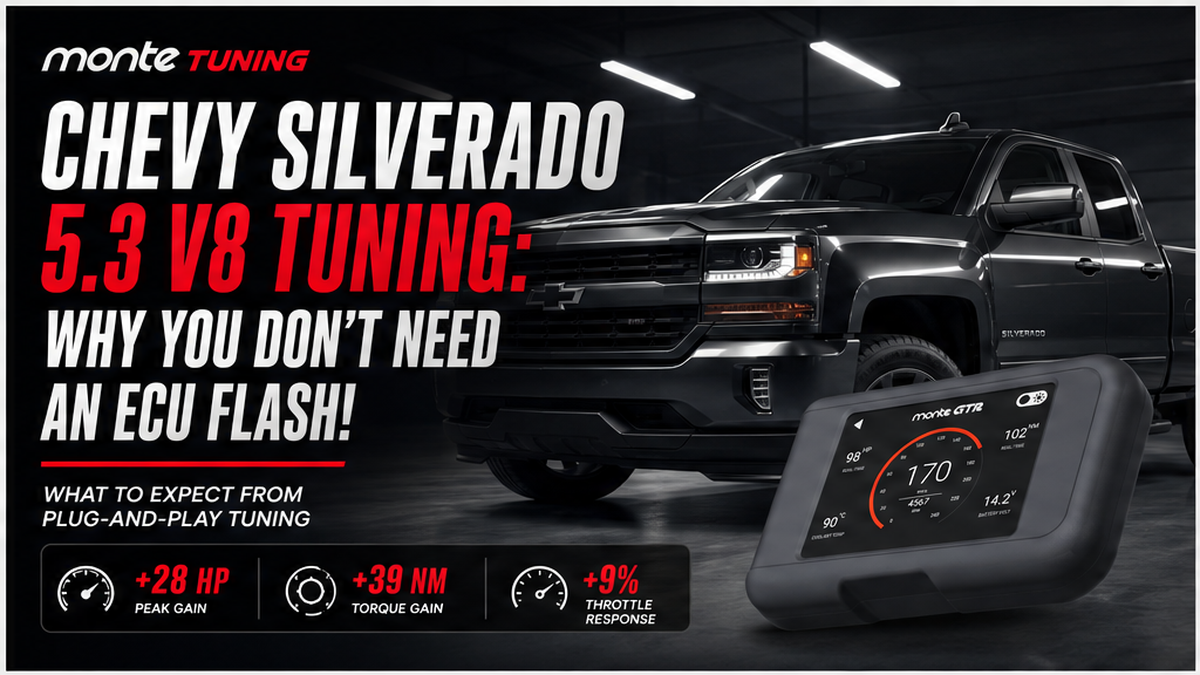
You bought your Chevy Silverado 5.3L V8 to haul loads, tow trailers, and drive daily. But when you step on the gas, a lazy throttle lag holds you back, and cylinder-deactivation shudder makes you worry about expensive lifter repairs. A plug-and-play OBD2 tuning module offers a safe, reversible solution to disable cylinder deactivation, eliminate lag, and restore your V8 engine’s true potential.
Tuning your Chevy Silverado 5.3L V8 does not require expensive dyno sessions or warranty-voiding engine flashes. A plug-and-play OBD2 tuning module safely disables cylinder deactivation (AFM/DFM), eliminates throttle lag, and adds up to 20–30 horsepower on premium fuel. This 15-minute upgrade keeps your engine in constant V8 mode to protect lifters, and is 100% reversible by unplugging the module before dealer service.
The Chevy 5.3L V8 is a legendary workhorse, but factory restrictions can make it feel sluggish. GM intentionally delay-shackles throttle response and forces the engine to run on fewer cylinders to meet strict fuel economy standards. This guide will show you how to safely unlock better performance and long-term reliability.
Identify Your Silverado 5.3L V8 Generation (L83 vs L84)
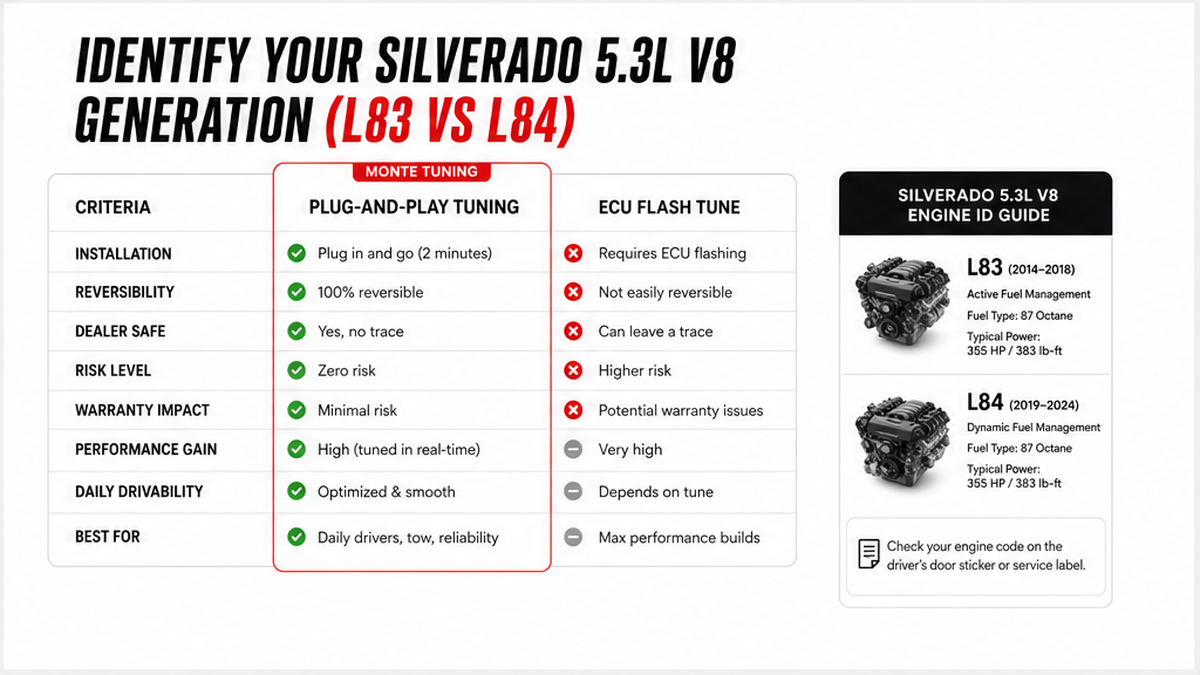
Before tuning, identify which 5.3L V8 version is under your hood. GM has used two cylinder-deactivation systems:
- 2014–2018 Silverado (L83): Active Fuel Management (AFM) shuts down four cylinders under light loads, turning your V8 into a V4. This causes a noticeable shudder and acceleration delay.
- 2019–2026+ Silverado (L84): Dynamic Fuel Management (DFM) runs the engine in 17 cylinder patterns, switching down to even two cylinders. While smoother, it multiplies mechanical complexity.
Both systems rely on lifters with spring-loaded locking pins. Constant cycling causes these pins to stick or break, leading to collapsed lifters and bent pushrods. Keeping your engine in constant V8 mode is the best preventative maintenance you can perform.
To protect your lifters and unlock your engine’s potential, a plug-and-play module like the Monte GT is the easiest way to start.
How Plug-and-Play OBD2 Tuning Works (No Flash, No Trace)
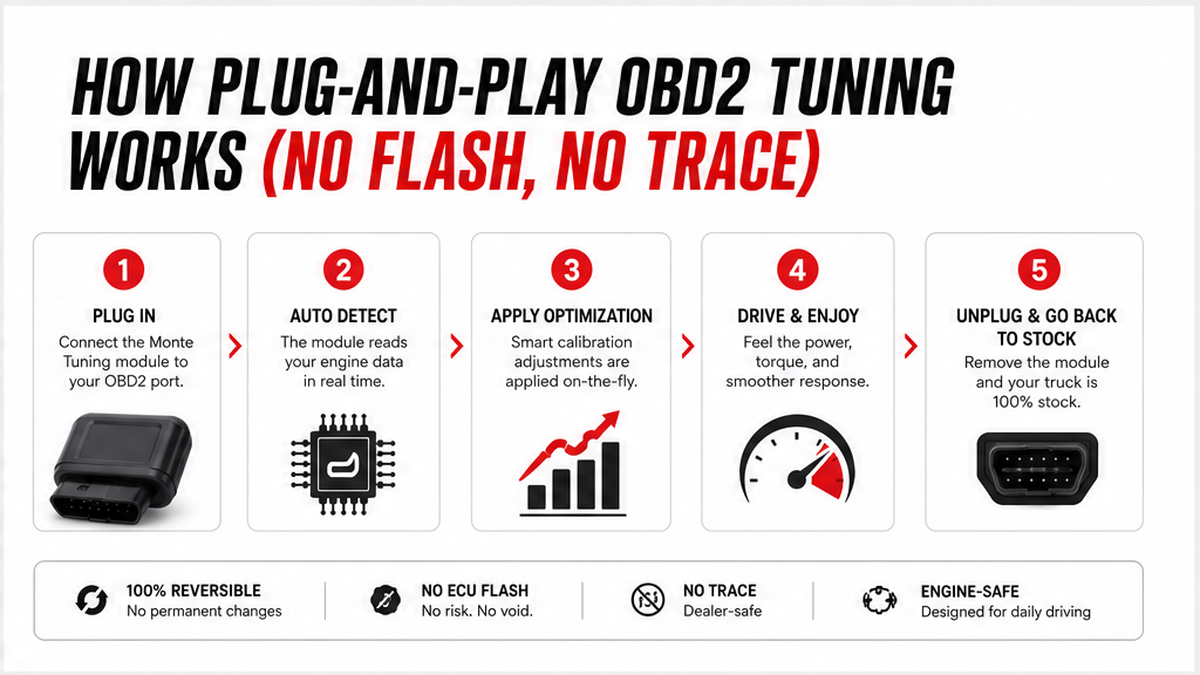
Traditional tuning uses an ECU flash (Engine Control Unit flash) to overwrite your truck’s computer. While it yields high peak numbers, it permanently alters factory software and triggers a digital “flash counter”. Dealership technicians can easily detect this modification, which instantly voids your powertrain warranty.
A plug-and-play OBD2 module works completely differently. Under your driver’s side dashboard, just above the pedals, is the OBD2 (On-Board Diagnostics) port.
Instead of rewriting software, a plug-and-play module plugs directly into this port and intercepts signals in real-time. It optimizes throttle sensitivity and prevents cylinder deactivation. The engine’s computer remains untouched, and no factory codes are rewritten.
This approach is 100% reversible. Before dealership service, simply unplug the module. Because the software was never flashed, there is no digital footprint left behind. Your truck returns to stock in less than 15 seconds.
Compare OBD2 Tuning vs. ECU Flash vs. Throttle Controllers
To choose the best path for your Silverado 5.3L V8, let’s compare three common modification methods: OBD2 plug-and-play modules, permanent ECU flashes, and basic throttle controllers.
A basic throttle controller only alters the gas pedal signal to make the truck feel more responsive. It adds no horsepower or torque and cannot disable cylinder deactivation. An ECU flash offers high performance but requires unlocking your computer (which is expensive and complex on newer models) and voids your warranty.
An OBD2 plug-and-play tuning module represents the perfect middle ground, offering real horsepower gains, full V8 mode protection, and complete reversibility. Here is how they stack up:
| Feature | OBD2 Tuning Module | Permanent ECU Flash | Throttle Controller |
|---|---|---|---|
| Horsepower & Torque Gains | Yes (Up to +20–30 HP) | Yes (Up to +35–40 HP) | No (Pedal feel only) |
| Disables AFM/DFM Shudder | Yes (Locks in V8 mode) | Yes (Requires custom tune) | No |
| Warranty Safe & Reversible | Yes (Unplug in 15 seconds) | No (Permanently flags ECU) | Yes (Pedal plug-in only) |
| Installation Difficulty | Very Easy (No tools required) | Hard (Requires bench unlock) | Easy (Plugs into pedal) |
Ready to experience real power?
Unlock up to 25% more horsepower and torque with a 100% reversible plug-and-play module. No tools required, installs in 15 minutes.
👉 Explore Monte Tuning Modules or Contact Our Tuning Experts for a free compatibility check!
Realistic Performance Gains: What to Expect on the Road
When tuning a daily-driven truck, you can expect a dramatic improvement in how your truck drives, hauls, and accelerates.
On a stock Silverado 5.3L V8, the factory engine is rated at 355 horsepower and 383 lb-ft of torque. Due to drivetrain power loss, the actual power reaching the wheels is around 290 wheel horsepower (whp).
Real-world dyno tests show that a high-quality OBD2 tuning module delivers:
- On 87 Octane Fuel: A solid gain of +15 to +17 wheel horsepower and +25 to +28 lb-ft of torque, with smoother shifting.
- On 91/93 Premium Fuel: Running premium fuel alongside optimized timing maps unlocks up to +20 to +30 horsepower, raising your wheel baseline closer to 320 whp.
The most noticeable change is the elimination of lazy pedal lag. The tuning module optimizes the throttle sensitivity map for instant response. When passing or towing, the power is there immediately, without the annoying V4-to-V8 transition shudder.
Step-by-Step Guide to Installing Your Tuning Module
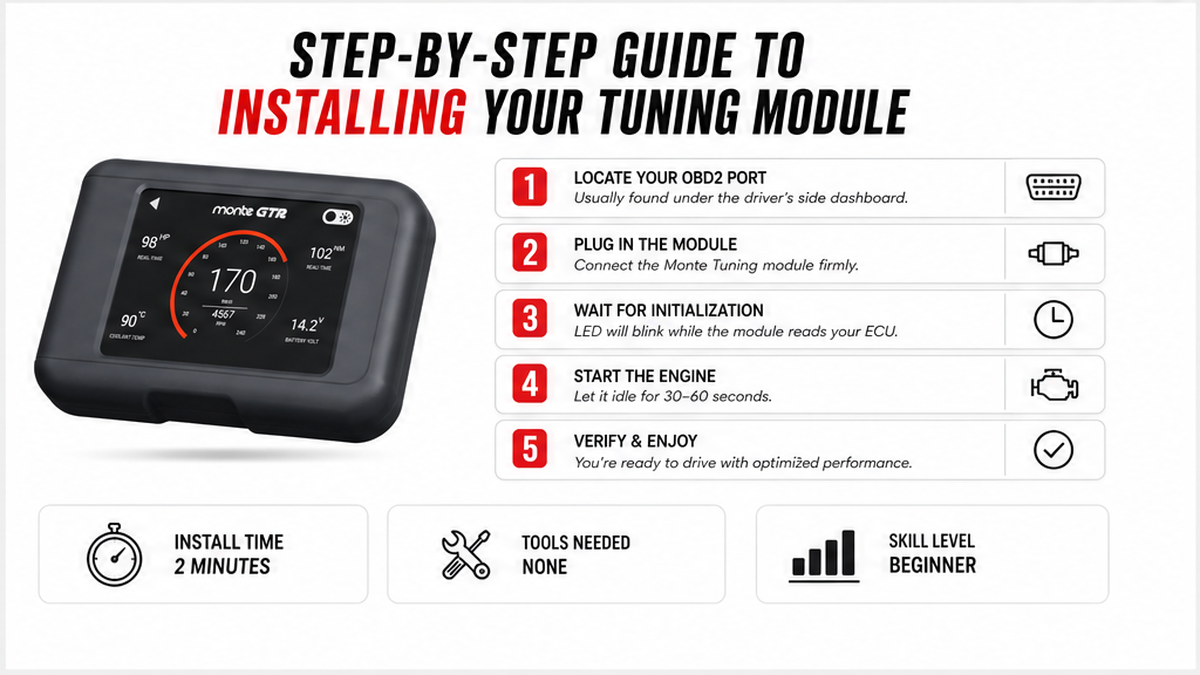
Installing a plug-and-play OBD2 tuning module is incredibly simple and requires no tools. Follow these six steps:
- Locate the OBD2 port: Look under the driver’s side dashboard, directly above the pedals, to find the trapezoid-shaped port.
- Confirm your engine generation: Identify whether your truck has the L83 engine (2014–2018 with AFM) or the L84 engine (2019–2026+ with DFM).
- Select your module: Choose a high-quality OBD2 module like the Monte GT or the premium, multi-channel Monte GTR.
- Plug the module in: With the ignition off, slide the module firmly into the OBD2 port and verify that the status LED indicators light up.
- Drive for adaptation: Drive normally for 50 to 100 miles. Your truck’s computer (ECU) will integrate the optimized performance and throttle mappings.
- Restore stock settings: Before dealership service, simply unplug the module. Your Silverado instantly reverts to stock with zero footprint.
What to Do Next to Protect Your Silverado V8
If you are tired of the constant V4-to-V8 shudder, sluggish throttle, and the fear of expensive lifter failures, it is time to take action. Protecting your Silverado 5.3L V8 is a simple matter of keeping all eight cylinders active.
By choosing a plug-and-play OBD2 tuning module, you get immediate throttle response, improved towing power, and a permanent V8 mode. All of this comes with a 100% reversible setup that keeps your warranty safe.
Your next step is simple. Select the perfect tuning module for your truck, or contact our support team for a free compatibility check.
👉 Select Your Monte Tuning Module or Contact Our Support Team today!
Article Verified By: Monte Tuning Editorial Team (Performance Tuning Support).
Data Accuracy: Engine specifications and dyno results verified against LS1Tech, FullSizeChevy, and HarrisTuning; search interest analyzed via Yandex Wordstat on July 2026.
Frequently Asked Questions
Will a plug-and-play OBD2 tuning module void my Silverado’s warranty?
No. Unlike ECU flashes that overwrite factory code, an OBD2 module only intercepts signals in real-time. Simply unplug it before visiting the dealership. It leaves no digital footprint, keeping your warranty intact.
What is the difference between AFM and DFM on a Chevy 5.3 V8?
AFM (2014–2018 L83 engine) shuts down four cylinders under light loads, turning your V8 into a V4. DFM (2019–2026+ L84 engine) features 17 cylinder patterns, switching down to even two cylinders. Both systems cause transition shudder and put mechanical stress on lifters.
How does keeping the engine in V8 mode protect my lifters?
Cylinder-deactivation systems rely on spring-loaded locking pins inside lifters. Constant cycling causes these pins to stick or break, leading to collapsed lifters. Constant V8 mode keeps lifters pressurized with engine oil, eliminating mechanical stress and preventing failure.
No, you can run on standard 87 octane fuel and still enjoy crisper throttle response and disabled cylinder deactivation. To unlock maximum gains of up to +20 to +30 horsepower, we recommend running premium fuel, which allows the module to optimize timing maps more aggressively.
How does an OBD2 tuning module compare to a basic throttle controller?
A basic throttle controller only alters the pedal signal to make the truck feel responsive. However, it adds no horsepower or torque and cannot disable cylinder deactivation. An OBD2 module optimizes throttle sensitivity and engine maps, delivering horsepower gains, smoother shifting, and constant V8 mode.