
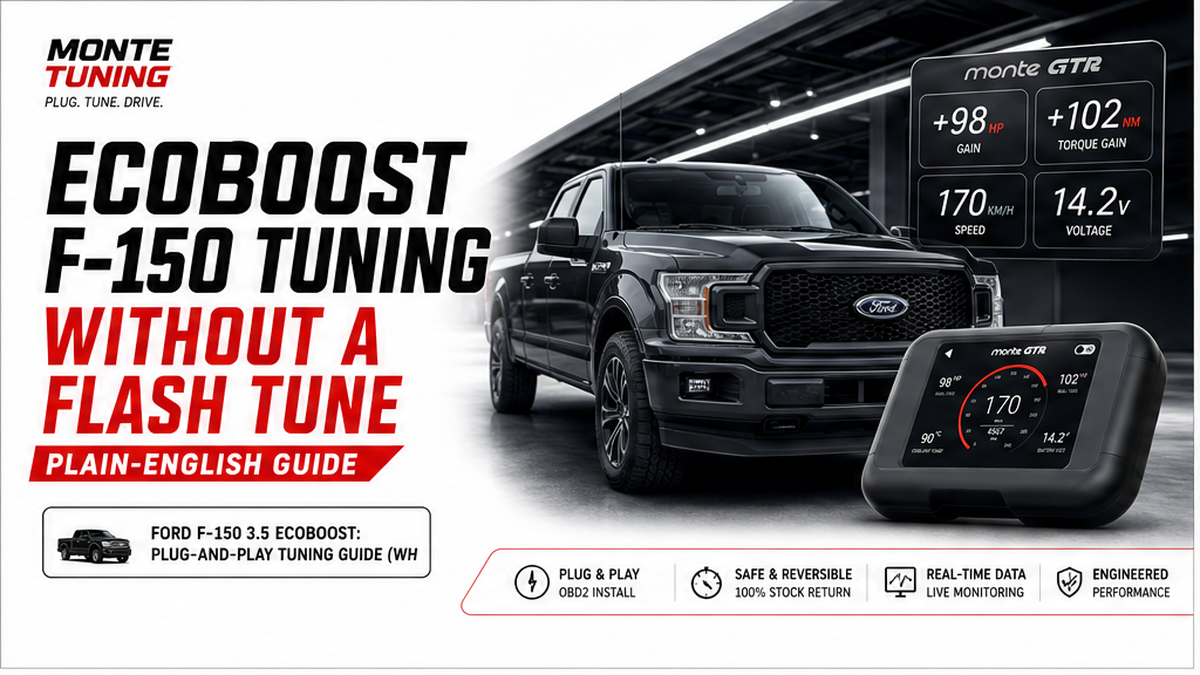
If your F-150 3.5 EcoBoost feels strong on paper but lazy when you merge, tow, or roll onto the highway, you are not imagining it. Ford’s twin-turbo V6 is tuned conservatively for emissions, heat management, and towing safety margins. You want quicker boost response without PCM unlock drama or a permanent flash. A plug-and-play OBD2 module adds sharper throttle feel and better mid-range pull while staying reversible.
A stock 3.5 EcoBoost F-150 can feel noticeably stronger with a quality plug-and-play OBD2 module because you optimize how the factory ECU manages boost, fuel, timing, and torque limits – not replace the entire calibration. Expect smoother spool and quicker response rather than race-car peak numbers. Remove the module before dealer service if you want a clean inspection. Match the module to your exact engine variant and model year before you buy.
This guide is for US owners comparing chip tuning vs ECU flash who want a plain-English workflow. We focus on plug-and-play OBD2 tuning for daily drivers who tow, commute, and need an easy return to stock.
Quick answer: what EcoBoost plug-and-play tuning does
Plug-and-play tuning means connecting a module to the OBD2 port (under the dash) so the engine computer runs an optimized map while the module is installed. Unlike a full ECU flash, you are not permanently rewriting Ford’s file. Unlike old signal-trick boxes, modern OBD2 modules work with the ECU’s knock, overheating, and limp-mode logic.
On a stock 3.5L twin-turbo truck, owners typically notice:
- Earlier, smoother turbo spool in everyday RPM ranges
- Stronger mid-range torque when passing or merging with a trailer
- Sharper throttle response without holding the pedal deeper
- Little or no change at idle when installed correctly
Typical mistake: expecting dyno peak horsepower on the first tank. EcoBoost trucks need adaptation miles before you judge the tune.
How EcoBoost tuning works in plain English
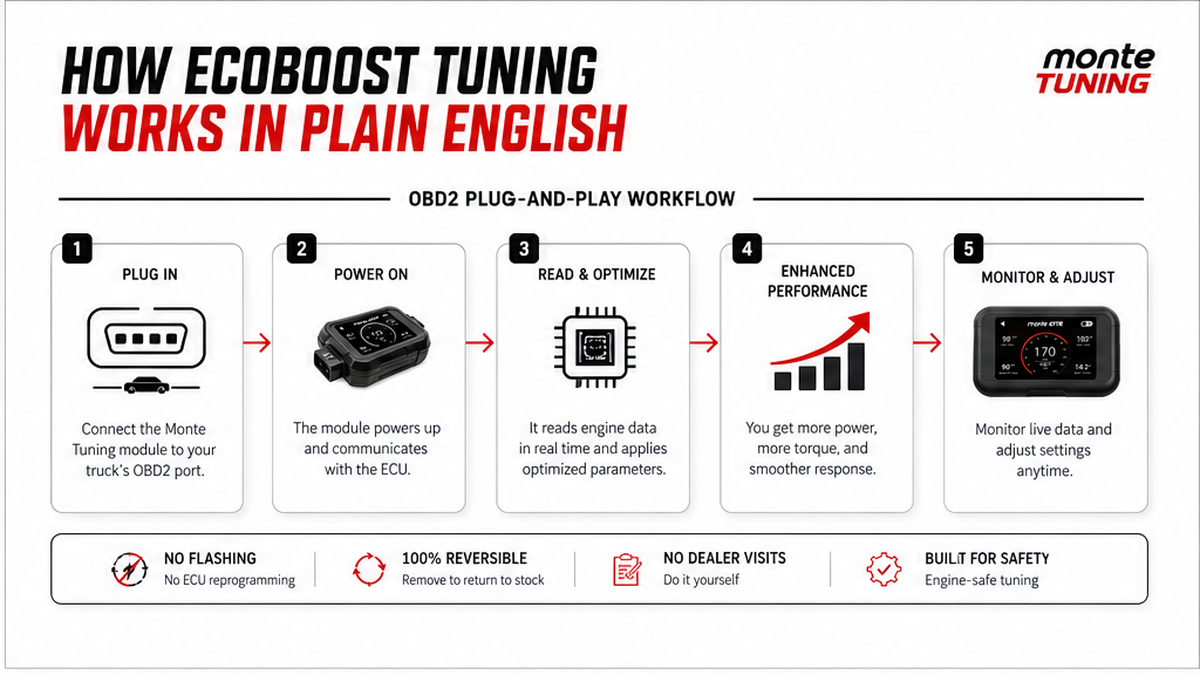
The ECU decides target boost, fuel, spark timing, and torque limits every millisecond. Ford ships a conservative map for hot climates, 87 octane, and heavy towing – which is why boost often feels soft down low even though the turbos can make serious power higher in the rev range.
A plug-and-play module loads an optimized calibration through OBD2. You give the ECU better instructions for daily driving and light towing while factory protections stay active. You are not bypassing knock sensors or wastegates; you ask the ECU to use more capability within safe limits.
For a deeper method comparison, read power boxes vs chip tuning.
Plug-and-play vs custom flash on a 3.5L EcoBoost F-150
| Factor | Plug-and-play OBD2 module | Custom ECU flash |
|---|---|---|
| Install | OBD2 port, often under 15 minutes | Tooling, shop time, or laptop workflow |
| Reversibility | Remove module to return to stock feel | Needs stock file reflash |
| Best for | Daily drivers, towing, first-time tuners | Modified builds, custom dyno maps |
| Dealer visit | Module removable before inspection | May leave digital traces |
What actually changes on your truck
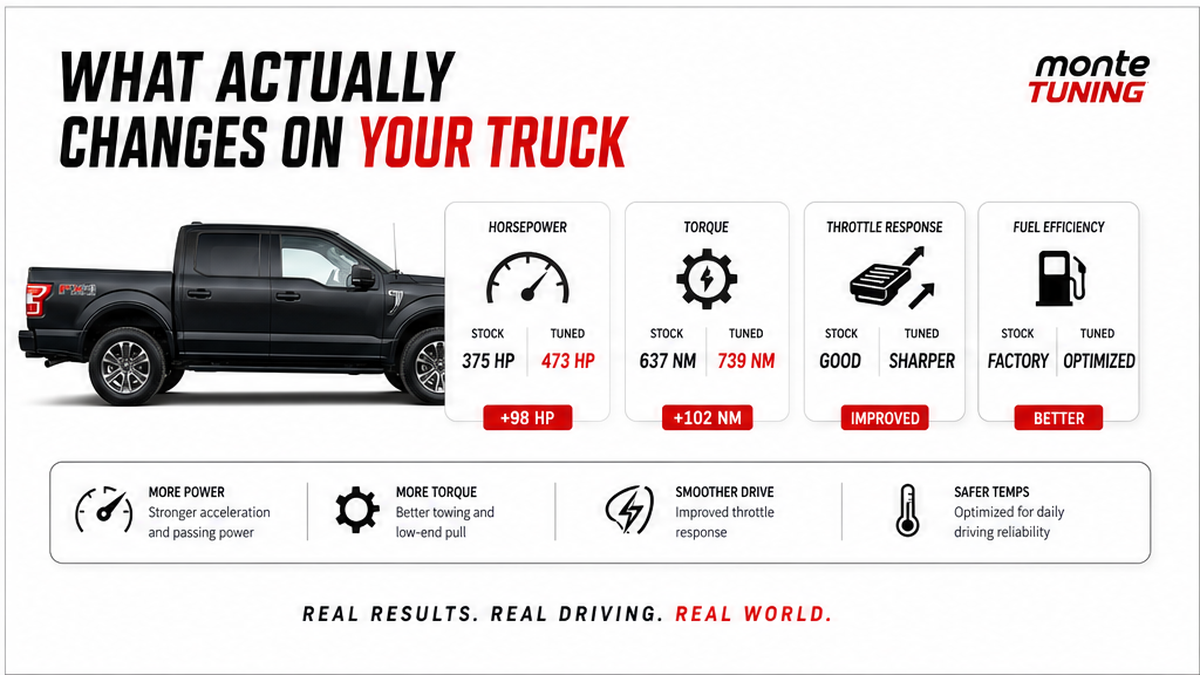
On a stock EcoBoost, calibration changes usually target:
- Boost and torque limits – more usable pull once turbos spool in the mid RPM range
- Throttle mapping – less pedal travel for the same acceleration
- Shift strategy – the 10-speed auto may hold gears differently under load
- Fuel and timing – optimized within factory knock and temperature guardrails
What does not change with a module alone: intake, exhaust, intercooler, turbo hardware, or internal engine parts. Heat-soaked intercoolers on long grades can still pull power back – tuning improves delivery, not cooling capacity. Confirm EcoBoost vs PowerBoost variant before ordering – wrong maps are a common avoidable mistake.
Monte Tuning markets up to 25% more horsepower and torque on the homepage. Treat that as a marketing ceiling, not a guarantee for every trim, fuel grade, altitude, or towing load.
Safety, warranty, and dealer visits
Is it safe on a stock EcoBoost? A reputable module should respect knock control and temperature limits. If you hear detonation, see repeated check-engine lights, or feel harsh shifting, stop driving aggressively, log the code, and contact support.
Warranty questions are common on turbo trucks. US law (Magnuson-Moss) generally requires a dealer to prove a modification caused a specific failure before denying unrelated work. A removable OBD2 module differs from a permanent flash: unplug before service. That does not guarantee zero questions, but it is what most daily drivers do.
Before dealer appointments:
- Unplug the module and stow it out of sight if you prefer no visual questions
- Drive normally a few miles so behavior returns to baseline
- Keep service records for unrelated repairs
15-minute install checklist
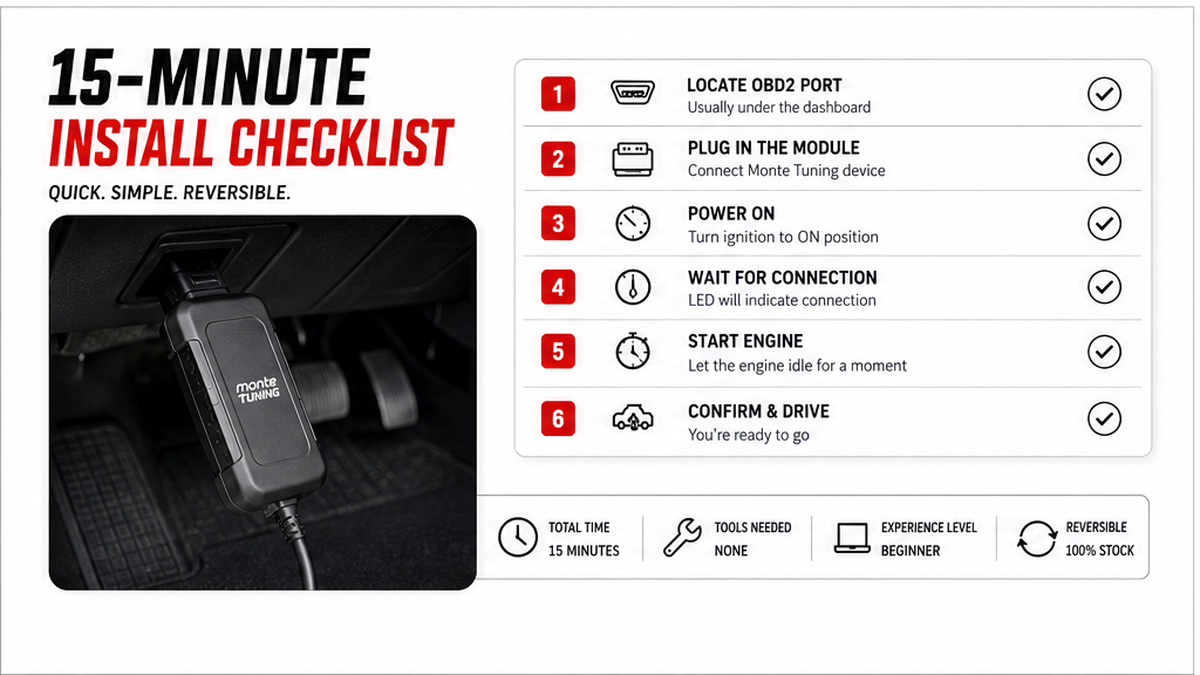
- Park level, ignition off, key away from the ignition
- Locate the OBD2 port under the driver side dash
- Confirm the module matches 3.5L EcoBoost (or supported PowerBoost) and model year
- Plug until fully seated – no connector wiggle
- Start the engine; confirm no immediate warning lights
- Drive 50-150 mixed miles before judging power or MPG
- Contact Monte Tuning support if day-one behavior feels wrong
Typical error: installing then immediately max-towing on the steepest grade. Break in with normal driving first.
Monte GT vs Monte GTR for EcoBoost F-150 owners
Both Monte GT and Monte GTR are plug-and-play OBD2 modules. Confirm compatibility for your year and engine variant on the product page or with support. GT is the entry flagship; GTR is the higher-tier calibration. Ask support before checkout if towing habits or fuel grade make you unsure.
Browse the shop once you know your VIN and engine code.
Common questions
Is EcoBoost plug-and-play tuning safe for daily driving?
When the module matches your truck and you drive within normal limits, daily commuting is the intended use. Contact support for repeated warnings or sustained overheating on long grades.
Will a plug-and-play tune help towing?
Many owners report easier passing and less downshifting under moderate loads because mid-range torque arrives earlier. It is not a substitute for hitch setup, trans cooling, or exceeding rated capacity.
Can I remove the module before dealer service?
Yes. Unplug, drive a few miles normally, then proceed with service.
What gains are realistic without a dyno?
Focus on quicker spool, stronger mid-range pull, and sharper throttle. Peak numbers vary by fuel and altitude. Monte Tuning cites up to 25% more horsepower and torque on the homepage as a marketing ceiling, not a per-truck promise.
Follow Ford’s requirement for your trim. Many EcoBoost trucks run fine on 87 octane stock; aggressive custom flashes sometimes demand 91/93. Read the module instructions for your map.
How is this different from a throttle controller?
A throttle controller changes pedal sensitivity only. An OBD2 module changes calibration parameters where boost and torque gains come from on a turbo engine.
What if I already have a handheld flash tuner?
Do not stack tools blindly. One calibration strategy at a time. Tell support if the ECU was previously flashed before adding any module.
Reviewed by: Monte Tuning editorial team (US plug-and-play tuning support).
Sources: Monte Tuning product pages and homepage marketing claims; general EcoBoost tuning practices from public aftermarket guides reviewed 2026-07-06. Verify compatibility for your VIN before purchase.
Ready to tune your EcoBoost F-150? Compare modules on the shop, or talk to support for a compatibility check before you order.